

How AI Handles Legal Jargon in Client Calls
AI voice agents explain complex legal terms to clients in plain English while cutting call handling time by 80% and capturing every detail.

Written by
Adam Stewart
Key Points
- Cut intake time by 80% with automated legal data collection
- Prevent AI errors using real case law databases for accurate responses
- Customize scripts for your practice area and local jurisdiction
- Flag urgent cases instantly with keyword detection and transcription
AI is transforming how law firms communicate with clients by simplifying legal jargon and improving call management. Here's how it's making a difference:
- 24/7 Availability: AI voice agents handle calls anytime, ensuring no missed opportunities.
- Simplified Legal Terms: Complex terms like "subpoena" are rephrased into plain language, making them easier for clients to understand.
- Accurate Context Understanding: AI uses advanced tools like Retrieval-Augmented Generation (RAG) to interpret legal terms based on real case law.
- Specialized Training: Systems are tailored to specific legal fields, ensuring accuracy for areas like family law or corporate law.
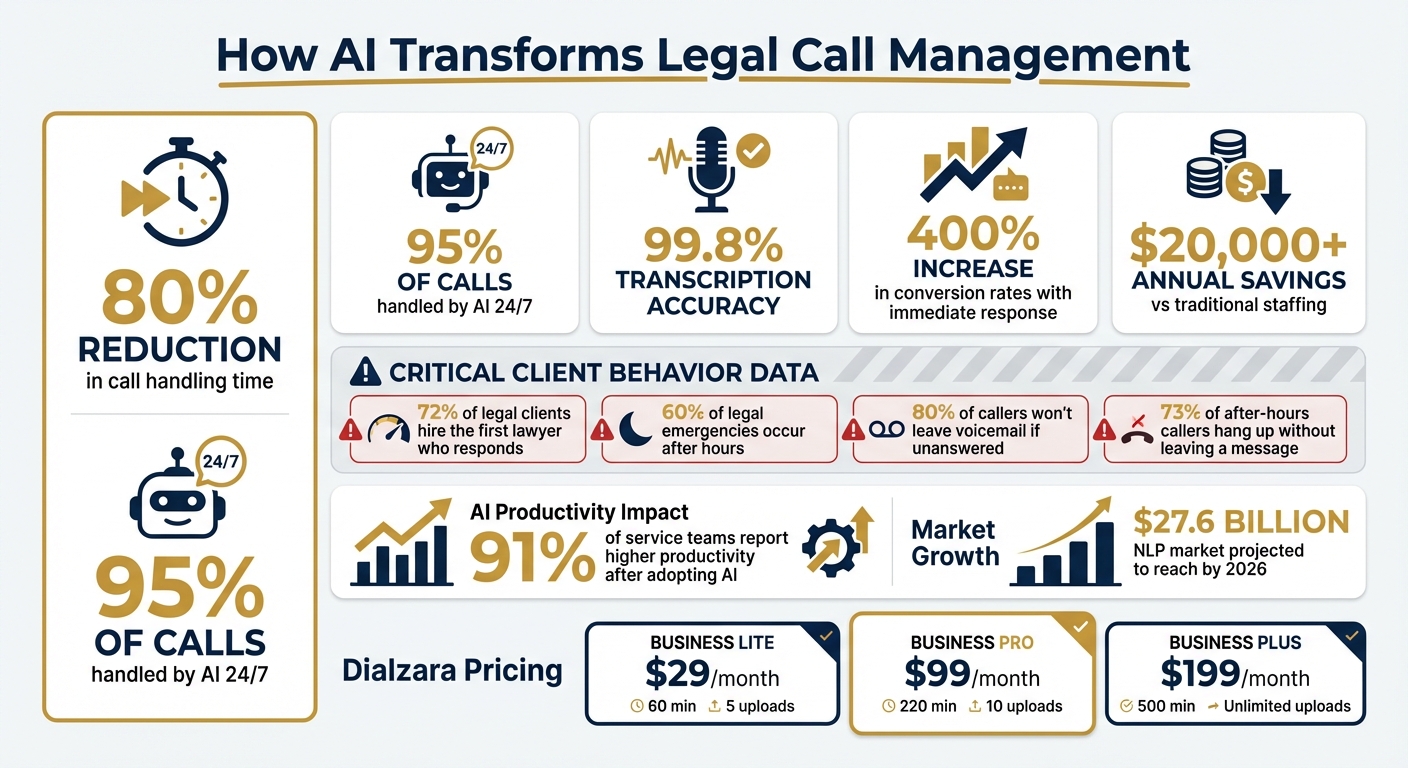
- Faster Intake Processes: AI collects client data efficiently, reducing call handling time by up to 80%.
- Real-Time Escalation: Urgent cases are flagged and passed to attorneys immediately, complete with detailed transcripts.
Dialzara is one such AI solution, offering accurate transcriptions, customizable scripts, and integration with legal tools. Plans start at $29/month, with a 7-day free trial to test its features. AI isn't just answering calls - it's reshaping how law firms operate, saving time, and improving client satisfaction.
AI Legal Call Management: Key Statistics and Benefits for Law Firms
How AI Processes Legal Terminology
AI gets to grips with legal terms by learning them in context. This begins with training on specialized legal databases filled with case law, statutes, and jurisdiction-specific glossaries. By tapping into trusted legal sources, AI can understand terms like "subpoena", "amicus curiae", or "habeas corpus" with accuracy.
One standout method is Retrieval-Augmented Generation (RAG). Here's how it works: when a client mentions a legal issue during a call, the AI pulls relevant sentences from real case law and legal databases in real time. This ensures precise context and minimizes errors. Researcher Jaromir Savelka highlights the benefit:
The augmentation leads to improved quality, and appears to eliminate the issue of hallucination, where models invent incorrect statements[6].
This approach lays the groundwork for AI to interpret a variety of legal scenarios with accuracy.
Training AI with Legal Databases
AI systems are trained using datasets packed with court rulings and legal documents[4]. This helps them understand legal terms in their proper context. For instance, the word "consideration" takes on a specific meaning in contract law, which is quite different from its everyday use.
More advanced systems employ concept-based search, which goes beyond basic keyword matching. For example, if a client says, "My neighbor's tree fell on my car", the AI can infer that the issue involves property damage, negligence, and liability - even if those exact terms aren’t used. By mapping plain language to legal concepts[2], the AI bridges the gap between casual descriptions and formal legal language.
Natural Language Processing for Context
AI’s ability to make sense of legal jargon relies heavily on Natural Language Processing (NLP). This technology converts spoken words into text in real time, identifies legal terms, and analyzes their context to better understand client needs[8].
During live calls, AI can spot critical keywords or phrases using pre-set triggers. Wade Coye, President and Attorney at Coye Law Firm, explains the advantage:
The ability to get an inbound call and have that speech-to-text transcription... and receive an instant notification - is awesome[8].
For example, if a client mentions "statute of limitations" or "breach of contract", the AI can immediately alert the attorney. By using NLP to grasp the context, AI adapts to various legal specialties with ease.
Customizing AI for Different Practice Areas
Legal terminology isn’t one-size-fits-all. A family law firm might need AI that understands terms like "custody" and "alimony", while a corporate law practice requires familiarity with concepts such as "indemnification" and "fiduciary duty." Today’s AI systems can be tailored with specialized intake scripts and keyword tracking to suit a firm’s specific focus[3][8].
These systems can also ask follow-up questions to refine their understanding. For instance, an AI might request the caller’s location to filter legal databases by jurisdiction[5]. This ensures it references the correct state laws and local regulations - a crucial step, given the wide variation in legal terms and procedures across the United States. This level of customization ensures that client interactions are both clear and legally accurate.
Improving Client Communication with AI
Once AI systems master legal terminology, they take it a step further by ensuring clients can actually understand these terms. The most advanced AI tools don’t just identify words like "tort" or "affidavit" - they break them down into plain, everyday language while keeping the legal meaning intact[2]. This ability makes it easier for clients to grasp important concepts without losing the nuances of legal intent.
Translating Legal Terms into Plain Language
AI excels at simplifying complicated legal jargon. For example, instead of using the term "habeas corpus", an AI might explain it as "a legal process that lets someone challenge being unlawfully held." This approach ensures that legal terms are not only recognized but also rephrased in a way that’s professional, clear, and easy for clients to follow[7][9]. During sensitive calls, AI agents adopt empathetic and calm tones to make the experience less stressful for clients[9].
The natural language processing (NLP) market is expected to hit $27.6 billion by 2026[2], largely thanks to the growing need for tools that simplify technical language and improve client understanding. Many law firms that use AI for intake calls report cutting call handling time by as much as 80%[9]. This means attorneys can redirect their energy toward more complex legal tasks instead of repeatedly explaining basic concepts.
But AI doesn’t stop at simplifying terms - it actively works to ensure clients stay on the same page through real-time feedback.
Real-Time Clarification and Feedback
Beyond translating legal jargon, AI systems take communication to the next level by clarifying client concerns in real time. They do this by asking follow-up questions and offering more details when they sense confusion. Some systems even use sentiment analysis to detect hesitation or frustration in a caller’s tone, prompting the AI to pause and provide additional explanations[8].
For example, if a client mentions a dispute with their landlord, the AI might respond, "Just to confirm, are you asking about your rights as a tenant in California?" This simple clarification step helps avoid misunderstandings and ensures both parties are on the same page.
AI can also assist attorneys during live calls by offering real-time coaching. If a client raises a challenging question or objects to something, the AI might suggest an appropriate response on the spot[8]. With 91% of service teams reporting higher productivity after adopting AI tools[8], it’s clear that these features are transforming how law firms handle client communication.
Using AI to Handle Legal Calls More Efficiently
AI is transforming how law firms manage legal calls, simplifying complex processes and saving valuable time. By automating repetitive tasks and identifying urgent matters, AI allows attorneys to dedicate their attention to more intricate legal work. This creates smoother client intake processes and ensures critical issues are addressed promptly.
Automating Client Intake and Data Collection
One of the most time-consuming aspects of legal work is gathering client information. AI tackles this challenge with tailored intake questionnaires. Whether it's a personal injury claim or an estate planning inquiry, AI systems ask the right questions and collect essential details like contact information, case summaries, and important dates [10][1].
AI-powered transcription tools also excel in accuracy, achieving rates as high as 99.8% [10]. This level of precision reduces errors common in manual data entry. Plus, the collected information seamlessly integrates with legal practice management software like Clio, MyCase, and PracticePanther [9][3][11]. By eliminating manual data transfers, law firms report up to an 80% reduction in call handling times [9]. Another major advantage? AI works 24/7, capturing leads even when the office is closed. This is vital, as 60% of legal emergencies occur after hours, and 73% of those callers hang up without leaving a message [12].
Escalating Complex Cases to Attorneys
While AI handles many tasks efficiently, not every call can be resolved without human intervention. Advanced AI systems are designed to detect critical keywords such as "arrest", "court deadline", or "emergency custody." When these terms are flagged, the system escalates the call to an on-call attorney, providing a detailed transcript and summary [9][11][12]. This ensures attorneys can step in without requiring clients to repeat themselves [11].
Quick responses to urgent legal inquiries can make a huge difference. Firms that respond immediately see a 400% increase in conversion rates compared to next-day callbacks [12]. This rapid escalation not only boosts client satisfaction but also helps secure high-value cases.
sbb-itb-ef0082b
How Dialzara Handles Legal Calls
Dialzara takes AI's ability to simplify legal communications to the next level, offering a tailored solution for handling legal calls. By analyzing context and intent, the platform processes queries with precision. Legal firms can upload practice-specific data - like documents and legal terminology - to train the AI for accurate and professional interactions [13][10].
Features for Legal Professionals
Dialzara provides 99.8% accurate call summaries and transcriptions [10]. Legal professionals can customize intake scripts to suit their specific areas of practice, such as personal injury, estate planning, or corporate law. The platform offers over 40 voice options, operates 24/7, integrates with more than 8,000 business applications via Zapier [15], syncs calendars, and supports bilingual communication. For more complex inquiries, the system seamlessly escalates calls to live attorneys, complete with detailed transcripts for context [13][14].
Cost Savings and Efficiency
Compared to traditional minute-based services, Dialzara provides cost-effective, flat-rate pricing. Plans include:
- Business Lite: $29/month for 60 minutes and 5 knowledge base uploads.
- Business Pro: $99/month for 220 minutes and 10 uploads.
- Business Plus: $199/month for 500 minutes, unlimited uploads, and white-glove prompt engineering [15].
This pricing ensures predictable costs while allowing firms to handle unlimited concurrent calls.
Setup and Configuration
Setting up Dialzara is quick and straightforward. Users create an account, answer a few practice-specific questions, pick a voice and phone number, and forward their existing line [10]. Most legal practices are fully operational within 72 hours [14]. During the "Train & Refine" phase, real-time feedback and test calls help fine-tune the AI's performance [13]. The platform also prioritizes security, ensuring attorney-client privilege is protected. A 7-day free trial is available for firms to explore its features risk-free.
Conclusion
AI is reshaping legal communication by breaking down complex jargon and making interactions more efficient. Thanks to advancements in natural language processing and tailored training, AI systems can now manage 95% of calls around the clock. They deliver the professionalism clients expect while also providing faster response times, boosting lead conversions, and saving law firms over $20,000 a year compared to traditional staffing costs[16].
Here’s a key insight: 72% of legal clients hire the first lawyer who responds, yet 80% of callers won’t leave a voicemail if their call goes unanswered[16]. That means every missed call is a missed opportunity. AI bridges this gap with 24/7 availability, ensuring no potential client falls through the cracks - all while significantly reducing operational costs.
In this dynamic environment, tools like Dialzara are setting a new benchmark for legal call management. Dialzara stands out by offering accurate transcriptions, automated client intake, and seamless integration with over 5,000 business applications. And the best part? It’s quick to set up - just a few minutes - and lets you focus on what truly matters: practicing law.
With flat-rate pricing starting at $29 per month and a 7-day free trial[17], Dialzara provides a practical, cost-effective way for law firms to improve client communication and capture more leads effortlessly.
FAQs
How does AI make legal language easier for clients to understand during calls?
AI leverages natural language processing (NLP) to break down complex legal terms into straightforward, easy-to-understand explanations. This makes it possible for clients to grasp intricate legal concepts without sacrificing accuracy or professionalism.
On top of that, AI can create detailed yet concise call summaries. These summaries help clients stay informed without being bogged down by heavy legal jargon, leading to clearer communication and a smoother, more enjoyable client experience.
How does AI understand and use legal terminology during client calls?
AI leverages Natural Language Processing (NLP) to interpret and use legal terminology effectively during client interactions. With NLP, AI can break down intricate legal phrases, pinpoint critical terms like indemnification, fiduciary duty, or force majeure, and grasp their meaning within the context of the conversation. This ensures responses are both accurate and professional.
To make this possible, NLP models undergo training using a vast array of legal documents and call transcripts. This training equips the AI to recognize specialized legal jargon and distinguish between terms that might have multiple interpretations. As a result, AI systems - such as Dialzara - can reliably capture client details, craft responses using legally precise language, and handle tasks like client intake or call routing efficiently. This combination of precision and reliability fosters trust and ensures smooth communication in legal settings.
How does Dialzara accurately handle legal terminology during client calls?
Dialzara ensures precise handling of legal terminology by blending specialized training with cutting-edge AI technology. When setting up your Dialzara agent, you can input details about your legal practice - such as specific terminology, common client inquiries, and areas of expertise. This process builds a tailored knowledge base, allowing the AI to seamlessly integrate industry-specific language into its interactions.
With the power of natural language processing (NLP) and real-time context awareness, the AI can grasp the caller's intent, tone, and even previous interactions. This enables it to deliver accurate, professional responses. Additionally, it uses custom intake scripts to collect essential details, ask relevant follow-up questions, and route calls efficiently.
Dialzara also features an advanced transcription engine that produces highly accurate call summaries. These summaries capture critical information - like key facts, dates, and legal terms - ensuring you don’t miss a thing. All of this is done while upholding strict standards of confidentiality and security.
Summarize with AI
Related Posts
How AI Improves Client Data Quality
AI tools enhance client data quality by reducing errors, improving accuracy, and streamlining workflows in real-time interactions.
HIPAA Compliance in AI Client Intake
Learn how AI client intake systems can maintain HIPAA compliance while enhancing data security and streamlining workflows.
Automate Legal Intake: 9 Steps to Simplify with AI
Discover how AI can revolutionize your law firm's legal intake process with these 9 essential steps, enhancing efficiency and client satisfaction.
How Speech-to-Text AI Improves Call Handling
Explore how speech-to-text AI revolutionizes call handling by automating interactions, enhancing efficiency, and significantly reducing costs.