

Predictive Analytics for Real Estate Lead Insights
Stop wasting 60% of your time on dead-end leads. AI analytics help you focus on prospects 3x more likely to buy.

Written by
Adam Stewart
Key Points
- Score leads with 85% accuracy using behavior patterns and market data
- Track property views and mortgage searches to predict buyer intent early
- Boost conversion rates from 12% to 38% with smarter lead prioritization
- Connect your CRM to automate follow-ups for high-scoring prospects
Predictive analytics is reshaping real estate by helping agents identify high-potential leads with AI lead qualification precision. Instead of wasting time on cold leads, agents can now focus on prospects most likely to buy or sell based on data-driven insights. Here's what you need to know:
- Problem: Agents spend 60% of their time on unqualified leads, with a low 2–3% conversion rate.
- Solution: Predictive analytics uses machine learning and big data to score leads (1–100) based on their likelihood to act.
- Impact: Teams using this approach have seen conversion rates jump from 12% to 38% and revenue grow by 67%.
- How It Works: Algorithms analyze demographic, behavioral, and market data to prioritize leads. Tools like voice stress analysis and real-time scoring improve accuracy to 70–85%.
- Benefits: Saves time, improves ROI, and increases efficiency by focusing on high-intent prospects.
For example, Metro Real Estate Group in Chicago used predictive tools to manage 2,000 leads monthly, boosting closings from 28 to 89 and adding $2.1M in revenue. Predictive analytics isn't just about better lead management - it's about smarter, faster decisions that drive results.
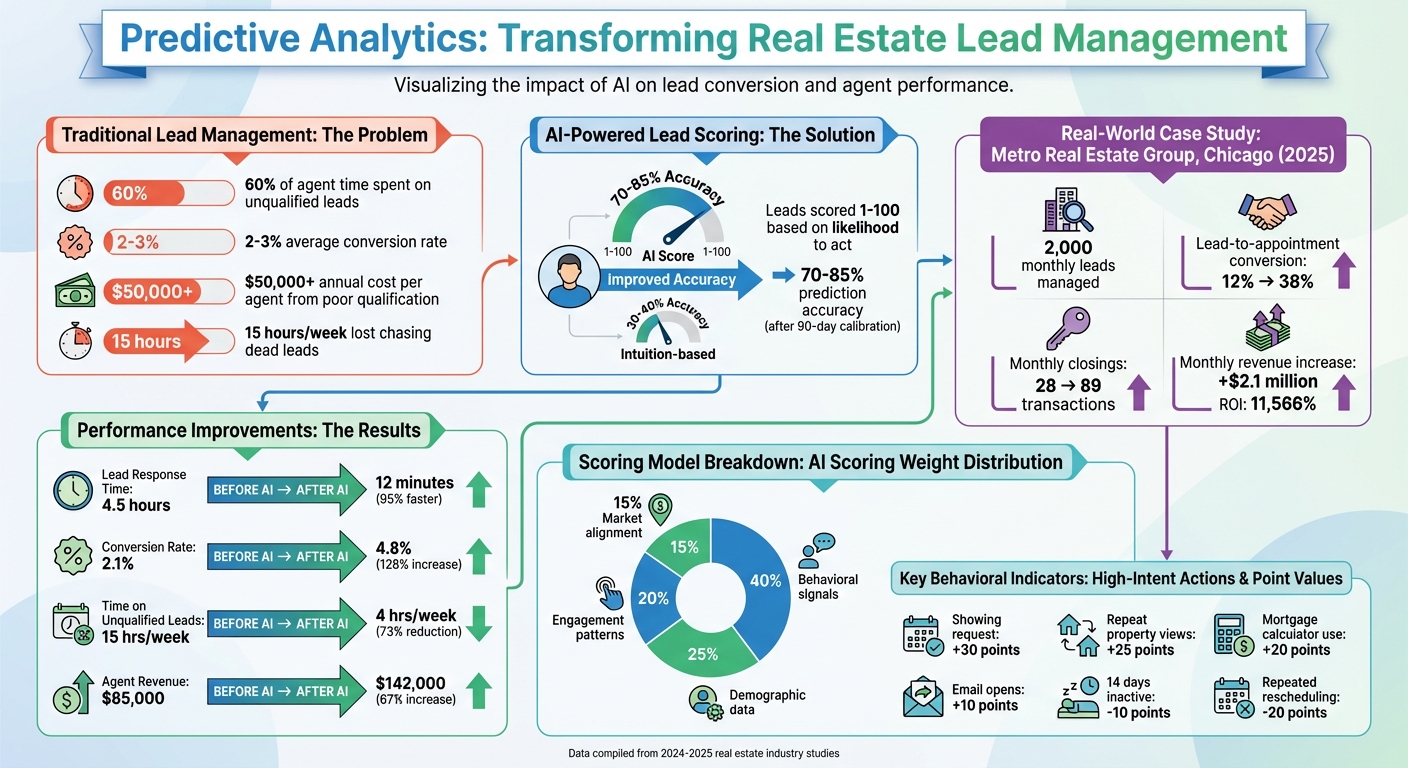
Predictive Analytics Impact on Real Estate Lead Conversion: Key Statistics and ROI
Data Sources for Real Estate Lead Analysis
Predictive analytics thrives on high-quality data from a variety of sources. The most advanced systems pull together multiple data points to create a detailed profile of each lead. These sources can be grouped into two main categories: demographic and behavioral data that explain who your prospects are and what they’re doing, and market trends and economic indicators that help predict when they’re likely to act. Together, these data elements feed into broader predictive models, creating a seamless and cohesive framework for analysis.
Demographic and Behavioral Data
Demographic data lays the groundwork for understanding a lead’s potential readiness to make a move. This includes key factors like pre-approval status, budget range, available down payment, and current living arrangements (renting vs. owning, lease expiration dates) [6][2]. Major life events - such as getting married, having a baby, changing jobs, or reaching the 5–7 year homeownership mark - are statistically linked to higher chances of a real estate transaction [8][5].
Behavioral data focuses on tracking a lead’s online activity. Actions like repeatedly viewing the same property, narrowing search filters (e.g., moving from "3-4 bedrooms" to "3 bedrooms in a specific zip code"), spending significant time on listing pages, or saving properties signal high intent [6][4]. Many scoring models assign point values to these behaviors: using a mortgage calculator might earn 20 points, submitting a showing request adds 30 points, and opening an email could be worth 10 points [8]. These behaviors often surface months before a lead is ready to finalize a deal.
Real-time tools like call analytics also play a role. These systems analyze speech patterns during phone calls to gauge urgency. For example, a lead mentioning specific budget details, asking about closing timelines, or responding quickly to outreach indicates a higher likelihood of moving forward [6]. Other indicators include email open rates above 40% and proactive actions like requesting documents or scheduling showings [6].
Not all data points are equally important. AI scoring models typically weigh 40% on behavioral signals, 25% on demographic data, 20% on engagement patterns, and 15% on market alignment [6]. This prioritization ensures agents focus on leads actively engaging with listings rather than those who simply meet demographic criteria. Negative scoring also comes into play - vague responses about timing may deduct 15 points, while repeated rescheduling can take off 20 points [4].
While these individual behaviors provide valuable insights, broader market conditions help complete the picture.
Market Trends and Economic Indicators
Understanding market conditions, both local and national, is critical for predicting when leads are most likely to act. Predictive models incorporate a range of economic and market indicators, such as mortgage rates, employment statistics, GDP growth, and Federal Reserve policies. These factors directly impact buyer and seller confidence [9][11].
In most AI models, local market alignment contributes about 15% to a lead’s overall score [6]. Factors like whether a prospect’s budget aligns with the median price range in their target area, the number of matching listings available (10+ listings tend to boost engagement), and inventory levels (markets with over 30 days on market typically favor buyers) all play a role [6].
Pricing trends and inventory shifts also provide critical insights. Historical price data can reveal the best time to list a property to attract buyers quickly [1][2]. For instance, in Decatur, Illinois, predictive software identified 2,024 properties likely to hit the market during a volatile period - 463 of them actually listed, giving agents months of advance notice before they appeared on the MLS [2]. This 1 in 5 accuracy rate highlights the power of market-level data in uncovering opportunities that traditional prospecting might miss.
"Predictive analytics harnesses technology to uncover emergent behavioral patterns within complex datasets, calculating probabilistic models to forecast future outcomes." – Gregory Ardbelava, Listing3D [1]
Beyond economic indicators, advanced systems now integrate geospatial and environmental data like walkability scores, school ratings, crime statistics, flood risks, and air quality metrics [9][11]. Some even use satellite imagery to spot construction activity or analyze social media sentiment to gauge a neighborhood’s popularity [11]. Financial triggers, such as unused home equity, signs of property distress, or recent refinancing, can also signal a homeowner’s likelihood to sell [1]. By combining these diverse data sources, predictive analytics can achieve forecasts with over 70% accuracy [7], giving agents a clear advantage in planning their outreach and timing their efforts.
sbb-itb-ef0082b
How Predictive Lead Scoring Works
Predictive lead scoring assigns a numeric value (ranging from 0 to 100) to each lead using real-time data. After a 90-day calibration period, this process achieves an accuracy rate of 75–85% [12][4]. By analyzing demographic, behavioral, and market data, the system ranks prospects more effectively. Unlike intuition-based methods - which hover around 30–40% accuracy - AI models process dozens of signals at once, helping agents focus on leads with the highest closing potential.
The system uses three main data types: explicit information (e.g., budget, pre-approval status), implicit behaviors (like property search trends or email engagement), and predictive indicators (such as life events or home equity positions) [12][6]. These inputs fuel machine learning algorithms that refine predictions over time. Unlike older systems that simply count website visits, modern AI evaluates the context and timing of actions. For instance, viewing the same three homes multiple times in a week signals stronger intent than browsing dozens of properties once [4][12].
"AI lead scoring does not make you a better agent. It makes you a better allocator of your own time. And in real estate, time allocation is everything." – AI Acceleration [12]
This dynamic system adjusts scores in real time. A lead’s score can spike instantly due to late-night property searches or a high-sentiment phone call, shifting them from "cold" to "hot" in minutes [4][12]. Advanced platforms even incorporate call analytics, which analyze voice stress, speech pace, and emotional tone to detect urgency with 91% accuracy [4]. Natural language processing (NLP) identifies intent keywords - like timeline details or financing discussions - and updates scores accordingly. These real-time adjustments are seamlessly integrated into machine learning models for deeper analysis.
Machine Learning Models for Lead Scoring
Machine learning algorithms drive predictive scoring by identifying patterns that are invisible to the human eye. These systems use techniques such as Decision Trees, Logistic Regression, Neural Networks, and Ensemble methods like Gradient Boosting to analyze both historical and current data [5][6]. By studying how past leads converted, these models can predict the likelihood of success with new prospects.
For optimal performance, models need 60–90 days of historical data and feedback [12][6]. During this time, the system learns which factors matter most in a given market, fine-tuning the importance of behaviors, demographics, engagement patterns, and local trends. For example, narrowing a search from a city-wide view to a specific subdivision may indicate 3–4 times higher conversion likelihood than traditional metrics suggest [4][12]. The algorithms also use decay scoring, deducting points (e.g., -10 points for 14 days of inactivity) to ensure lead priorities remain accurate [13].
Real-Time Scoring in CRM Systems
Real-time scoring takes CRM integration to the next level by automating immediate responses. When connected to a CRM, predictive scoring triggers workflows based on lead scores [12][13]. For example, leads scoring 80–100 (the "Hot" range) might be added to a "Priority Call" list, send an alert to the assigned agent, or initiate a personalized text - all within minutes of a score update.
In a 2025 case study, Metro Real Estate Group in Chicago used AI call analytics alongside lead scoring to manage over 2,000 monthly leads. By identifying urgency through sentiment analysis, their 15-agent team increased lead-to-appointment conversions from 12% to 38%, boosting monthly closings from 28 to 89 transactions. This added $2.1 million in monthly revenue and delivered an ROI of 11,566% [4].
Most CRM systems use tiered follow-up strategies based on lead scores. For instance:
- 80–100: Personal calls within an hour and priority scheduling.
- 60–79: Contact within 24 hours with tailored listing recommendations.
- 40–59: Automated nurture campaigns featuring weekly updates.
- Below 40: Long-term drip campaigns with quarterly follow-ups [12].
This segmentation ensures that 78% of buyers who select the first agent to respond [6] receive prompt, personalized service when their score signals readiness.
Agents are encouraged to set score-jump alerts for increases of 15–20 points within 48 hours, as these spikes often indicate a shift from casual browsing to serious buying intent [12]. With AI scoring reducing time spent on unqualified leads by 73% [6] and increasing conversion rates by 128% [6], integrating real-time scoring into daily workflows is now a key strategy for staying competitive.
Benefits of Predictive Analytics for Real Estate Sales
Predictive analytics takes the guesswork out of real estate sales, helping agents zero in on leads with the highest potential. Instead of treating every lead the same, agents can focus their energy on prospects who are more likely to buy or sell - sometimes months before they even reach out. This shift to a data-driven approach increases both efficiency and profitability.
On average, agents lose about 15 hours each week chasing unqualified leads [6]. Predictive analytics changes the game by automatically identifying high-potential prospects and routing them to the right agent. This efficiency boost cuts wasted time by 73% [6], freeing agents to build stronger relationships with leads that are more likely to convert into closed deals.
Better Lead Prioritization
Predictive scoring brings clarity and confidence to lead prioritization. By assigning scores or grades to leads, agents can quickly identify which prospects deserve immediate attention. For example, high-scoring leads might trigger a personal call or priority scheduling, while lower-scoring leads can be added to long-term nurture campaigns. Behavioral signals, such as browsing patterns or engagement, further validate a lead’s intent.
One case study highlighted a 1-in-5 conversion rate from properties flagged by predictive tools, giving agents a significant head start over their competition [2].
"Predictive analytics removes the uncertainty from prospecting by using past data and current trends to help you zero in on high-potential leads."
– Steve Cortez, Owner, ArchAgent [2]
This targeted approach not only improves conversion rates but also ensures resources are allocated where they’ll have the most impact.
Higher ROI Through Data-Driven Decisions
When agents prioritize leads based on predictive insights, the financial payoff becomes clear. By focusing on high-scoring prospects, agents achieve a turnover rate of 27%, which is 4.6 times the national average [7]. The bottom line? Agents using predictive tools see their annual revenue climb from $85,000 to $142,000 - a 67% increase [6].
Lead scoring also boosts conversion rates. While the typical agent converts just 2%–3% of leads [2], predictive analytics can push that figure to 4.8%, a 128% improvement [6]. For example, a Dallas-based real estate team managing 700 online leads per month used AI scoring to focus on the top 20% of leads. In just one quarter, their appointment set rate rose from 6% to 9%, and their outbound call volume dropped by 25% [14].
The cost of poor lead qualification is steep - over $50,000 per agent annually [6]. Predictive analytics helps agents identify "silent sellers", such as homeowners going through life changes like marriage, divorce, or empty nesting. By building connections early, agents position themselves as the go-to choice when those homeowners are ready to sell.
| Metric | Before AI Implementation | After AI Implementation | Improvement |
|---|---|---|---|
| Lead Response Time | 4.5 hours | 12 minutes | 95% faster |
| Conversion Rate | 2.1% | 4.8% | 128% increase |
| Unqualified Lead Time | 15 hours/week | 4 hours/week | 73% reduction |
| Agent Revenue | $85,000 | $142,000 | 67% increase |
Source: [6]
Predictive analytics also helps teams stretch their marketing budgets. Instead of relying on broad advertising campaigns, agents can target neighborhoods and demographics with the highest conversion potential. For instance, predictive models can identify "look-alike" homeowners - those who share similarities with past successful sellers in the same ZIP code. This enables agents to launch precise campaigns tailored to those profiles, reducing wasted ad spend and increasing response rates across all marketing channels.
Integrating Dialzara with Predictive Analytics

Predictive analytics can highlight which leads are most likely to convert, but that knowledge is only useful if you can act on it immediately. Imagine a high-scoring prospect calling your office - every second matters. By connecting predictive insights with real-time action, Dialzara revolutionizes how agents engage with high-intent leads, ensuring no important call is ever missed, no matter the time.
This AI-powered phone answering service is ready to go within minutes and integrates with over 5,000 business tools, including leading real estate CRMs. With this setup, predictive lead scores can automatically trigger specific call handling protocols. High-value prospects get the attention they deserve the moment they reach out, perfectly complementing the predictive models you’re already using.
How Dialzara Handles High-Priority Leads
When predictive models identify a lead as high-priority - whether it’s because they’ve submitted a showing request (30 points), repeatedly viewed the same property (25 points), or used a mortgage calculator (20 points) - Dialzara ensures those calls are handled with care and urgency [8]. For example, if a lead scoring 75 points calls at 10:00 PM on a Saturday, Dialzara doesn’t just answer. It gathers their property preferences and even schedules a showing, all in real time.
Dialzara doesn’t just stop at answering calls. It screens them, collects vital information, and routes high-priority leads to your top agents. At the same time, it logs all the details into your CRM to ensure consistent follow-up. Whether it’s transferring calls, relaying messages, or managing client intake, Dialzara maintains the professional standards your business relies on.
Integration with Real Estate CRMs
Dialzara’s real-time call prioritization becomes even more powerful when integrated with your CRM. Through API connections - the same technology that embeds predictive analytics into your operations - Dialzara syncs call data, bookings, and lead details with platforms like Salesforce and other real estate-focused CRMs [15].
This integration creates a streamlined workflow where predictive lead scores guide how Dialzara manages each call. High-scoring leads are routed to your best agents, while lower-priority prospects might enter an automated nurture sequence. Dialzara also tracks behavioral data, such as the properties callers inquire about or the questions they ask, feeding this information back into your predictive models to improve future scoring accuracy [5].
Currently, over 72% of real estate firms are using predictive analytics [15]. Dialzara ensures that every call - no matter how busy your team is - receives professional handling. This leads to faster response times, improved lead capture, and higher conversion rates, all without the need to hire additional staff or deal with HR headaches.
Steps to Implement Predictive Analytics Tools
Getting started with predictive analytics in real estate requires a methodical approach. The process begins with evaluating your current systems and ensuring the data you rely on is accurate and reliable. Skipping these steps can lead to flawed predictions and wasted resources. Start by assessing your data infrastructure and then layer in market-specific intelligence to build a solid foundation.
Evaluate Your Current Data and Tools
Before diving into new predictive tools, take a close look at your existing data. Problems like incomplete records or duplicate entries can skew predictions, leading to wasted marketing budgets and unproductive leads [16]. Review sources like your CRM, MLS feeds, and any third-party databases to confirm that property records are accurate and contact details are up-to-date.
It's also essential to confirm whether your current systems can support real-time forecasting. As Gina Baker from HousingWire puts it:
"The data is only as reliable as the sources used" [10].
To ensure your data is ready for predictive analytics, establish a plan for quality checks and compliance with regulations like GDPR [16]. Additionally, check if your CRM already includes built-in predictive features or if you'll need to integrate with third-party platforms [17]. For example, PropStream offers basic property valuation tools starting at $99/month, while advanced options like Top Producer's Smart Targeting start at $599/month [10].
Train Models on Local Market Data
One-size-fits-all predictive models won’t cut it in real estate. Markets differ dramatically - what works in Austin might fail in Detroit. To make your model effective, incorporate regional sales data to identify patterns specific to your area. These could include pricing trends, employment shifts, inventory levels, or life events like retirement or divorce that drive seller behavior [1]. For instance, SmartZip achieved a 72% prediction accuracy for home listings by using localized data [7].
Set thresholds and test variables that reflect your market’s nuances. Factors like mortgage rates, changes in school districts, or new commercial developments can all influence closing potential [1]. Once your model is tailored to your local market, monitor its performance regularly to ensure it remains effective.
Monitor and Optimize Performance
Predictive analytics isn’t a "set it and forget it" tool. Advanced systems continuously learn and adapt based on outcomes, refining their accuracy over time [5]. Regular audits are crucial to identify gaps or inaccuracies in your data [5]. For example, if your model consistently overestimates interest from a particular demographic, investigate the reasons behind it.
Compare predictions to actual outcomes and adjust your model as needed. Zillow’s Zestimate algorithm, for instance, maintains a median error rate of 5.9%, with predictions for over 90% of homes sold in many metro areas falling within 5% of the actual price [15][16]. Aim for similar accuracy by incorporating conversion data into your model. Integrate your predictive platform with your CRM so that changes in lead scores automatically trigger the AI-driven lead engagement strategies [1].
Stay informed about advancements in proptech by attending industry events and exploring new tools as they emerge. This ongoing effort will help you refine both your data and your localized models, ensuring your predictive analytics system remains effective over time.
Conclusion
The progress outlined in this guide showcases how predictive analytics is reshaping lead management in real estate. Instead of pursuing every inquiry, agents can now focus on high-potential prospects with an impressive accuracy rate of 70–85%. This shift from a broad approach to precision targeting has led to notable improvements in lead-to-appointment conversions and overall revenue growth, as evidenced by various case studies [4].
To fully leverage these advantages, combine predictive models with real-time tools. For instance, Dialzara (https://dialzara.com) offers 24/7 call handling, screening, and routing for top-priority leads. With integrations for over 5,000 business applications, including leading real estate CRMs, Dialzara ensures that critical leads are addressed without delay.
As Bill Lublin, President of the Pennsylvania Association of Realtors, aptly puts it:
"Revaluate turns suspects into prospects, and converts data to dollars" [3].
By adopting predictive analytics, agents can build meaningful relationships with motivated buyers and sellers, gaining a head start over competitors.
To get started, evaluate the quality of your existing data with AI reporting for real estate leads, train models tailored to your local market, and integrate tools that act on predictive insights instantly. The tools are available - the choice is whether to act now and gain an edge or risk falling behind. Predictive analytics has the power to revolutionize your lead strategy and elevate your business.
FAQs
What data is needed to start predictive lead scoring?
To get started with predictive lead scoring in real estate, you'll need to gather key data that highlights lead behaviors, preferences, and other signals. This includes:
- Behavioral data: Actions like property views, website activity, and use of tools like mortgage calculators.
- Explicit details: Information such as budget, property preferences, timeline, and whether the lead has pre-approval.
- Historical transaction data: Trends and patterns from both successful and unsuccessful past deals.
- CRM insights: Notes, call logs, and email interactions stored in your customer relationship management system.
By collecting and analyzing this information, AI tools can effectively score leads and predict how likely they are to buy or sell.
How long does it take to get accurate lead scores?
The time it takes to produce accurate lead scores using predictive analytics largely hinges on the quality of the data and the capabilities of the system in use. Many tools can generate initial results in just minutes. However, as the system processes more data over days or weeks, the accuracy of these scores tends to improve. Most systems are built to deliver reliable results swiftly, allowing real estate professionals to prioritize their leads effectively and make timely decisions based on the insights provided.
How can Dialzara help me act on high-scoring leads faster?
Dialzara uses AI to analyze over 150 behavioral signals, scoring leads with an impressive 92% accuracy. This means you can zero in on the prospects most likely to make a purchase within the next three months, saving time and effort.
The platform doesn’t stop there. Its automated system takes care of lead qualification, sends instant responses, and even schedules follow-ups. This eliminates delays and ensures you can act quickly on high-priority prospects, helping you close deals faster and improve overall sales efficiency.
Summarize with AI
Related Posts
AI Reporting for Real Estate Leads
Explore how AI is revolutionizing real estate lead reporting, enhancing efficiency and decision-making through automation and real-time insights.
Predictive Analytics for Real Estate Social Media Leads
Explore how predictive analytics is transforming real estate lead generation on social media, enhancing efficiency and targeting high-quality prospects.
How AI Identifies High-Value Real Estate Leads
AI revolutionizes real estate lead generation by analyzing behavioral signals to identify high-value prospects and enhance conversion rates.
ChatGPT for Real Estate Leads: The Complete AI Lead Qualification Guide for 2025
Explore how AI tools enhance real estate lead qualification by automating tasks, improving lead quality, and increasing conversion rates.