

5 Ways AI Builds Customer Trust in Small Businesses
Turn AI from a trust barrier into your biggest competitive advantage. These proven strategies help small businesses build stronger customer relationships.

Written by
Adam Stewart
Key Points
- Be upfront about AI use - transparency builds 8.5x more trust than hiding it
- Minimize data collection and explain privacy policies in plain English
- Keep humans available when AI can't solve complex customer problems
- Use AI to personalize service without crossing privacy boundaries
AI can help small businesses build trust by improving transparency, protecting data, ensuring accuracy, offering personalization, and balancing automation with human support. Here’s how it works:
- Transparency: Clearly inform customers when they’re interacting with AI. Honesty builds confidence and reduces frustration.
- Data Protection: Secure customer information by following privacy laws and limiting data collection to what’s necessary.
- Accuracy: Train AI for your business to provide reliable, correct responses. Use human oversight for complex cases.
- Personalization: Tailor interactions based on general preferences without overstepping boundaries. Explain how data is used.
- Human-AI Balance: Let AI automate repetitive tasks while humans manage sensitive or complex issues.
Key takeaway: AI works best when it complements human efforts, respects privacy, and delivers clear, reliable, and tailored experiences. Small businesses that use AI responsibly can strengthen customer relationships and trust.
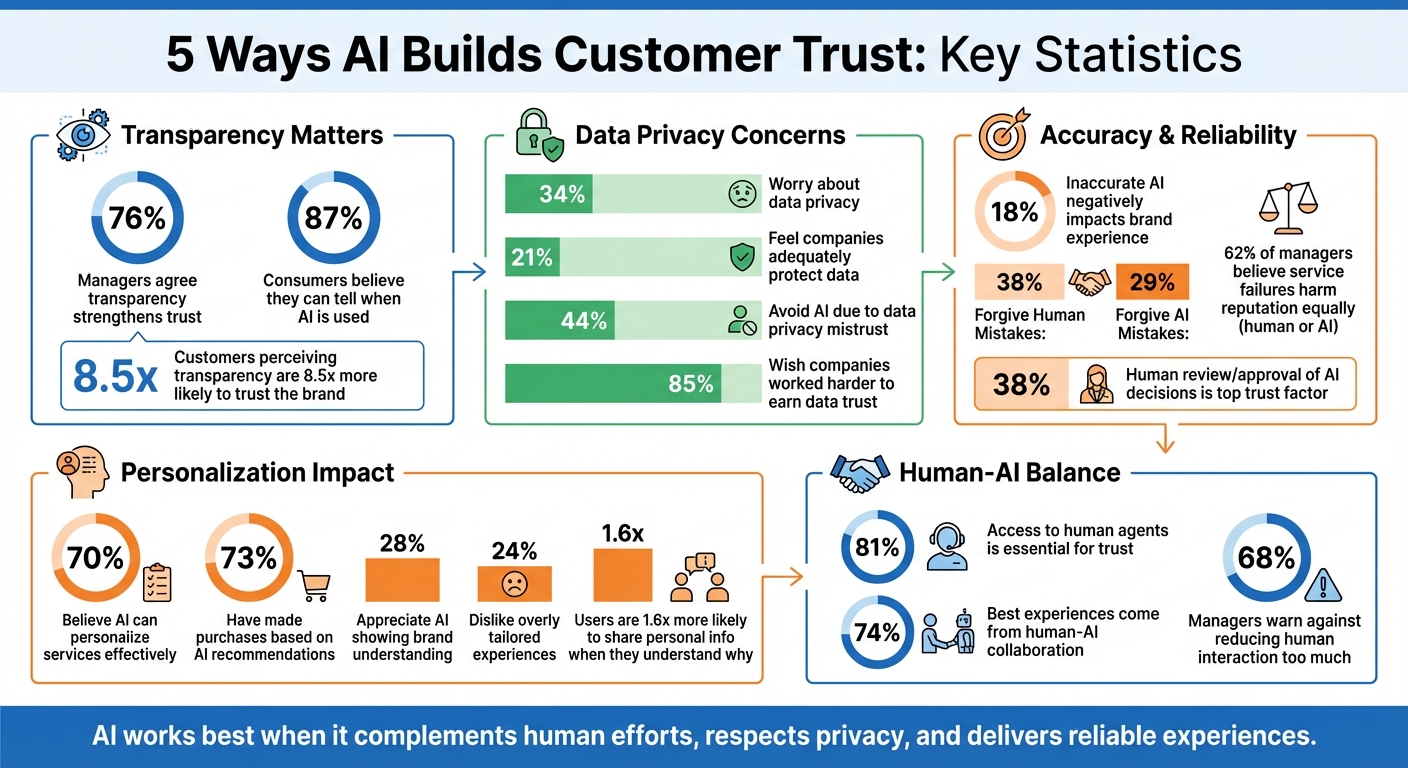
AI Customer Trust Statistics: Key Data on Transparency, Privacy, and Personalization
1. Be Clear About When Customers Are Talking to AI
Transparency in AI Usage
Honesty is the foundation of trust. When customers interact with your AI systems, they should know right away that they're dealing with an automated service. Research backs this up: 76% of managers agree that being upfront about AI usage strengthens customer trust. In fact, customers who perceive an AI system as transparent are 8.5 times more likely to place high trust in the brand [2] [4].
Consumers are paying attention. A large majority - 87% - believe they can tell when a company is using AI [1]. Trying to mask the role of AI can backfire, creating suspicion and eroding trust if the truth comes to light. Instead, embrace AI as a tool and make it part of the customer experience. A simple introduction like, "Hi, I'm an AI assistant here to help you faster. If you'd prefer to speak with a human, just let me know", sets the right expectations [7].
Take Helium SEO as an example. In July 2025, they introduced AI chatbots to manage client inquiries. Their CTO, Paul DeMott, ensured the technology was upfront about its identity. He noted:
"The moment we introduced a chatbot to help manage incoming client queries, I knew the tech could not pretend to be a person... That transparency alone cuts down on frustration" [8].
This approach isn’t limited to online interactions. Phone-based AI systems can also benefit from clear communication. For instance, if you’re using a service like Dialzara, program your AI agent to introduce itself right at the start of the call. Customers appreciate knowing they’re speaking with an AI that’s available 24/7, especially when they still have the option to connect with a human if needed. Being upfront about AI involvement highlights a commitment to customer satisfaction.
sbb-itb-ef0082b
2. Protect Customer Data and Follow Privacy Laws
Data Privacy and Security Measures
It's no secret that customers are cautious about how AI systems handle their personal information. Recent studies show that 34% of consumers worry about data privacy when using AI [1], and only 21% feel companies are doing enough to protect their data [6]. Even more telling, 44% of people who avoid AI entirely cite mistrust in data privacy as their main reason [5].
For small businesses, safeguarding customer data starts with smart, practical steps. One key practice is data minimization - only collect the information you truly need to provide value. For instance, if your AI-powered phone service can book appointments without requiring credit card details, don’t ask for them. You can also use automated tools to redact sensitive information, like Social Security numbers or payment details, and enforce strict data retention policies to ensure unnecessary information is deleted.
When incorporating third-party AI tools, your internal security measures are just the beginning. It’s essential to thoroughly vet your vendors. Investigate how they store and process data because, at the end of the day, your business is responsible for protecting customer information. For example, if you're using a service like Dialzara to manage phone calls, ensure the integration is secure and that their data protection measures align with your own. This diligence is vital for maintaining trust in a world increasingly reliant on data.
Transparency plays a huge role in reinforcing these efforts. A great example comes from Autodesk, which introduced AI Transparency Cards for its Construction Cloud Photo Autotags feature in January 2026. These cards explained the AI’s purpose, the data it used, and how that data was protected. The results? Transparency scores jumped by 26%, reliability scores rose by 13%, and customer trust improved by 7% [4]. As the Harvard Business Review put it:
"Transparency doesn't mean showing everything. It means showing what matters - clearly, consistently, and with purpose" [4].
Instead of burying details in lengthy legal jargon, use plain-language disclosures to communicate how you handle data. For example, phrases like "We use your appointment history to send reminders" or "Call recordings are deleted after 90 days" are simple yet effective. This approach not only complies with privacy laws but also builds trust. With 85% of consumers wishing companies would work harder to earn their trust regarding data handling [5], clear and honest communication is more than a legal requirement - it’s a competitive advantage.
3. Provide Reliable and Correct Information Every Time
Accuracy and Reliability of AI Responses
Accuracy is the backbone of trust when it comes to AI. Mistakes, especially in customer-facing interactions, can leave a lasting impression. In fact, 18% of consumers say that inaccurate AI recommendations negatively impact their experience with a brand [1]. And it’s not just customers who notice - 62% of managers believe service failures harm a brand’s reputation equally, whether caused by a human or AI [2]. Interestingly, customers are often harsher on AI errors: while 38% are forgiving of human mistakes, only 29% extend the same understanding to AI [2].
So how can businesses ensure their AI consistently delivers accurate information? It starts with domain-specific training. Your AI should be tailored to understand your business, including its unique terminology, customer needs, and frequently asked questions. For example, Dialzara equips its AI phone agents with a customized setup process. By learning about your services and customer interactions from the start, the AI is prepared to "speak your language" right away. Once trained, begin assigning it simple, low-risk tasks like confirming appointments, providing business hours, or checking order statuses. These straightforward interactions are a great way to test and refine its reliability before moving on to more complex scenarios.
To further enhance trust, implement confidence thresholds. Program your AI to escalate to a human agent whenever its confidence in a response dips below a set level - such as 80%. This "human-in-the-loop" approach is vital, as 38% of users say having a human review or approve AI decisions is their top trust factor [5]. Regular audits are also essential. Weekly reviews of AI responses can help identify inaccuracies or "hallucinations" before they become a problem [1].
Another strategy is to use tentative language in responses. Phrases like "Based on your appointment history" or "This appears to be" signal that the AI is offering assistance rather than making definitive claims [3]. Additionally, monitor customer feedback through metrics like "dismiss" or "unsubscribe" rates after AI interactions. These indicators provide valuable insights into how customers perceive the accuracy of your system [1].
As Cristina Fonseca, Head of AI at Zendesk, wisely notes:
"Transparency is fundamental to getting the long-term trust of administrators, agents and, ultimately, customers" [6].
4. Customize Interactions Based on Customer Needs
Personalization Capabilities of AI
Personalization is about creating value for customers without making them feel uneasy. When handled properly, AI can help customers feel both understood and appreciated. In fact, 70% of customers believe AI can personalize services effectively, and 73% have made purchases based on AI recommendations[1][6].
A low-intrusion approach works best. Focus on general indicators like category preferences, whether the customer is new or returning, and contextual details like their location or the timing of their call. For example, Dialzara equips its AI phone agents with training tailored to your business's terminology and customer interaction style. This enables the AI to grasp customer intent and respond appropriately - whether confirming a returning client's appointment or answering detailed, industry-specific questions for a first-time caller. This kind of setup ensures the AI aligns with customer expectations while respecting ethical boundaries.
Striking the right balance in personalization is key. While 28% of consumers appreciate AI when it shows that a brand understands their needs[1], 24% dislike overly tailored experiences[1]. Transparency about how data is used can ease these concerns. For instance, explaining that a recommendation is "based on your previous appointment" removes the mystery and builds trust. Offering customers control over personalization settings, like a simple "not for me" option, also gives them the power to shape future interactions. When people understand why certain suggestions are made, they’re 1.6 times more likely to share personal information[4].
5. Balance AI Automation with Human Support
Integration of AI and Human Touch
The most effective AI strategies combine automation with human expertise. In fact, 81% of customers say access to a human agent is essential for maintaining trust in AI-driven customer service[6]. Similarly, 74% of managers believe the best customer experiences arise from collaboration between human and AI agents[2].
The secret lies in dividing tasks wisely. AI excels at repetitive, straightforward jobs - like answering FAQs, checking appointment availability, or sharing business hours. On the other hand, humans are indispensable for handling complex or emotional situations, such as calming upset customers, making exceptions to policies, or resolving issues that require nuanced judgment. For instance, Dialzara operates 24/7 to manage routine calls but immediately escalates sensitive or intricate inquiries to a human agent, ensuring customers don't have to repeat themselves. This thoughtful balance builds trust and highlights a commitment to using AI ethically - combining efficiency with empathy.
A "human-in-the-loop" approach follows AI customer support best practices to strengthen trust by ensuring that critical situations are addressed without delay. Train your AI to recognize its boundaries - whether it's low confidence in understanding a request, detecting customer frustration, or handling questions about refunds. These scenarios should trigger an instant handoff to a human agent. The goal isn’t to hide humans behind AI but to use automation to handle repetitive tasks, freeing your team to focus on the meaningful, relationship-driven moments that truly matter.
It's worth noting that 68% of managers caution against reducing human interaction too much, warning it could harm long-term customer loyalty[2]. Think of AI as a tool that amplifies your team's capabilities rather than replacing them. When customers know they can rely on a human when needed - and see AI as a way to save time - their trust in your brand naturally grows.
Conclusion
Building customer trust with AI hinges on ethical practices and transparency. Summarizing the five strategies discussed earlier, the foundation of trust lies in these principles: clearly communicate when AI is in use, prioritize data protection with strong security protocols, ensure accuracy in AI-driven interactions, tailor experiences without being invasive, and always provide an accessible route to human assistance when needed.
When applied thoughtfully, AI becomes a tool to strengthen customer relationships, not undermine them. Transparent AI systems foster trust, while misuse can alienate customers.
"AI doesn't create trust. Useful, respectful experiences do - and AI just happens to be great at that." - 3L3C [1]
For small businesses seeking practical ways to adopt these strategies, Dialzara offers a compelling solution. With 24/7 availability, integration with over 5,000 business applications, and the ability to handle routine tasks while escalating complex issues to human agents, Dialzara seamlessly blends AI with human support. This approach not only enhances customer service but also builds stronger, trust-based connections by aligning technology with ethical values.
"Trust isn't just a value; it's the bridge between promises and results." - Richard Olayanju, Data Professional [7]
Leveraging AI to create smoother, respectful interactions is more than just embracing technology - it's about nurturing meaningful, long-term relationships.
FAQs
How do I tell customers they’re talking to AI?
To build trust, it's important to be open and clear from the very beginning. Let users know they’re interacting with an AI assistant by saying something like, “This call is handled by an AI system.” This upfront approach helps set expectations.
Additionally, reassure users by explaining the AI’s purpose, emphasizing how their data is protected, and always offering the option to connect with a human if they prefer. This level of transparency can go a long way in creating confidence and ensuring a smooth, positive experience.
What data should my AI collect (and not collect)?
Your AI should focus on collecting data that directly improves the customer experience. This might include preferences, common inquiries, or interaction history to deliver more efficient and tailored service. Avoid gathering sensitive or unrelated information, like financial or health details, to safeguard privacy. Always be upfront about how data is used, secure customer consent, and prioritize ethical practices to earn trust while respecting their privacy.
When should my AI hand off to a human?
When customers request to speak with a human or seem hesitant - like asking for reassurance or repeating themselves - it's crucial for the AI to seamlessly transfer them to a human representative. Providing this option not only builds trust but also ensures a more tailored and empathetic interaction. Human involvement plays a key role in resolving concerns and reinforcing customer confidence in the AI system.
Summarize with AI
Related Posts
Explainable AI in Customer Service: Transparency & Trust
Learn about the importance of explainable AI in customer service, transparency, and trust. Find out how businesses can implement clear AI to build trust, keep customers happy, and create lasting relationships.
5 Ways AI Improves Customer Retention
Discover how AI improves customer retention through predicting churn, personalizing interactions, streamlining support, analyzing feedback, and creating engaging loyalty programs.
Why AI Transparency Matters for SMBs
AI transparency is essential for small businesses to build trust, ensure compliance, and enhance operational efficiency in an evolving digital landscape.
Ethical AI in Customer Service: Building Trust
Discover how ethical AI in customer service can enhance trust, reduce bias, and improve experiences with transparency, fairness, and data security.