
AI Call Agents vs. TCPA: Compliance Checklist
Avoid $1,500-per-call penalties with this compliance roadmap for AI calling systems that keeps your business safe.

Written by
Adam Stewart
Key Points
- Get written consent for each specific offer - blanket permissions don't work anymore
- Document every call and keep records for 5+ years to prove compliance
- Process opt-out requests within 10 days or face FCC violations
- Clearly identify your company on every AI call - it's required by law
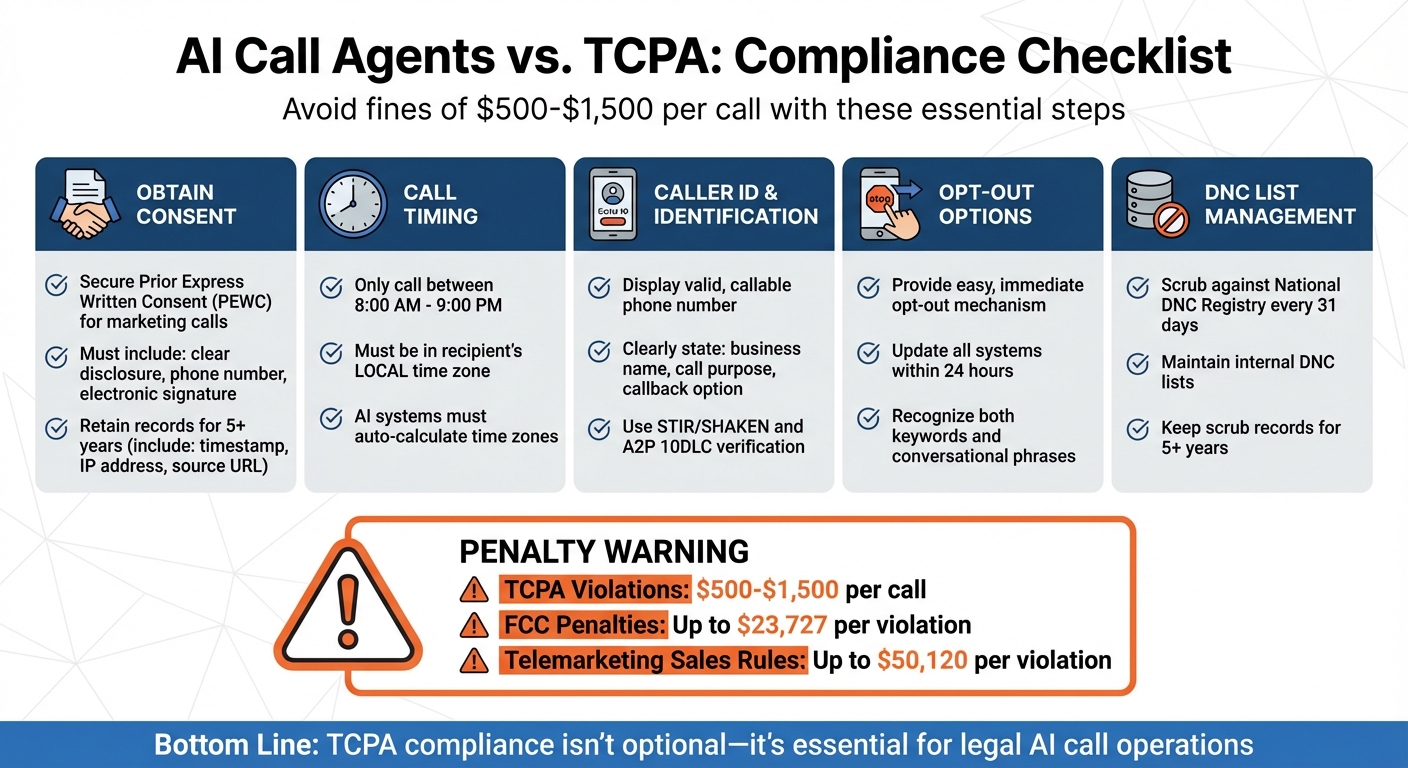
AI call agents must follow strict TCPA (Telephone Consumer Protection Act) rules to avoid hefty fines ranging from $500 to $1,500 per call. The FCC's 2024 ruling classifies AI-generated voices as "artificial voices", holding them to the same standards as traditional robocalls. Key compliance steps include:
- Obtain Consent: Secure prior express written consent (PEWC) for marketing calls. Retain detailed records for at least five years.
- Call Timing: Only call between 8:00 AM and 9:00 PM in the recipient's local time.
- Caller ID and Identification: Display a valid number and clearly identify the business and call purpose.
- Opt-Out Options: Provide easy, immediate opt-out mechanisms and update systems within 24 hours.
- DNC List Management: Scrub against the National Do Not Call Registry every 31 days and maintain internal DNC lists.
Non-compliance risks include penalties from federal and state regulations, with fines up to $50,120 per violation under Telemarketing Sales Rules. It is also important to stay informed on FTC rules for AI chatbots to ensure full consumer protection compliance. Automated tools like Dialzara can simplify compliance by managing consent, DNC checks, and record-keeping in real time.
Bottom Line: TCPA compliance isn't optional. Proper consent, clear identification, and robust record-keeping are critical to avoid legal risks and ensure AI call agents operate within the law.
TCPA Compliance Checklist for AI Call Agents
TCPA Requirements for AI Call Agents
Under the FCC's rules, AI-generated voices are classified as "artificial voices" under the TCPA, meaning they must adhere to the same regulations. Businesses using AI call agents need to comply with federal requirements in three key areas: consent, call timing and identification, and opt-out mechanisms. Below is a breakdown of these compliance areas to ensure your AI call agents meet TCPA standards.
Consent Requirements for AI Calls
For telemarketing or marketing-related calls, obtaining prior express written consent (PEWC) is a must. According to the FCC's 2024 guidance, consent must be specific - consumers need to give explicit permission to a named seller. General or blanket consent is no longer acceptable. A valid digital consent record should include:
- A clear disclosure of the consent terms
- The phone number authorized for calls
- The consumer's electronic signature
Importantly, consent cannot be tied to the purchase of goods or services. For non-marketing calls (like appointment reminders or account alerts), transaction consent is sufficient.
Even for inbound calls initiated by the consumer, AI systems may need to comply with state wiretapping laws by providing recording disclosures. Additionally, businesses should retain consent records for at least five years, including details like the source URL, timestamp, and IP address. This ensures compliance and provides documentation in the event of a dispute. [1][2]
Call Timing and Caller Identification
Once consent is secured, businesses must follow strict rules for call timing and identification. Telemarketing calls are only allowed between 8:00 AM and 9:00 PM in the recipient's local time. AI systems should automatically calculate the recipient's time zone, factoring in number portability, to avoid violations.
Each outbound call must display a valid, callable phone number and include accurate company identification. AI call agents must clearly state:
- The business name
- The purpose of the call
- A callback option
To comply with the Truth in Caller ID Act, businesses need to use a static, actively monitored caller ID. Violations of this act can result in penalties of up to $10,000 per instance. Implementing technologies like STIR/SHAKEN and A2P 10DLC can help ensure calls are verified and reduce the chances of being flagged as spam. [1][2]
Opt-Out Options and Do Not Call Lists
To remain compliant, businesses must regularly scrub their call lists against the National Do Not Call Registry, at least once every 31 days, to maintain safe harbor protection. Additionally, companies must maintain their own internal do-not-call (DNC) list and a corresponding policy.
AI call agents should provide an easy-to-use opt-out mechanism during calls. This could include:
- A button press option through an AI and IVR system
- Recognizing natural language commands like "stop calling me"
If a consumer opts out, the request must be processed and updated across all systems - including the AI dialer, CRM integration, and internal DNC databases - within 24 hours. To streamline this, businesses can use API-based real-time lookups to ensure all DNC lists are up to date. Keep records of each DNC scrub event, including the date and registry version, for at least five years to demonstrate compliance.
sbb-itb-ef0082b
Record-Keeping and Documentation
Keeping detailed, tamper-proof records is essential for defending against FCC and TCPA claims. Without proper documentation, proving compliance is almost impossible - and violations can lead to fines ranging from $500 to $1,500 per call, with FCC penalties going as high as $23,727 per violation [2].
"Documentation is the backbone of a defensible AI call compliance program." [2]
Your compliance records should cover every step of the customer interaction, from obtaining consent to processing opt-outs. These records demonstrate that your AI call agents are following TCPA standards. Below is a breakdown of the critical records you need to maintain.
Records You Need to Keep
The table below outlines the key types of records, the specific data to capture, and why they are essential for compliance.
| Record Type | Specific Data to Capture | Retention Purpose |
|---|---|---|
| Consent Logs | Timestamp, IP address, source URL, electronic signature, archived page version of consent | Prove prior express written consent for AI/automated calls |
| DNC Scrub Logs | Date of scrub, registry data version, phone numbers checked, matches found | Defend against DNC registry violations |
| Call Detail Records | Call time, duration, system ID, outcome (answered/voicemail), recipient number | Show compliance with time-of-day and call frequency rules |
| Opt-Out Records | Method of request (IVR, verbal, text), date and time processed | Confirm opt-out requests were honored within 30 days |
| Training Logs | Employee names, training dates, TCPA topics covered | Prove "reasonable procedures" to prevent violations |
When it comes to consent records, it's crucial to capture the exact appearance of the consent form as the consumer saw it. This includes storing a timestamped screenshot or archived version of the page, the specific language of the disclosure, the consumer's IP address, and the source URL [2]. Always verify the validity of consent records yourself, even if they come from a lead supplier.
"The legal liability falls on the company that made the call, not the company that generated the lead." [2]
These records are a critical part of your compliance strategy, reinforcing your adherence to consent, call timing, and opt-out requirements.
How Long to Keep Records
TCPA records - including consent logs, DNC scrubs, call details, opt-out requests, and training documents - should be retained for at least five years from the last interaction with the consumer [2][1].
To ensure defensibility, store these records in tamper-resistant systems that include audit trails. This means using formats that track and show any modifications or deletions, preserving the integrity of your documentation [2]. Additionally, conduct quarterly audits of active campaigns to review consent forms and verify DNC scrubs. These proactive reviews help identify and fix any compliance gaps, supporting the continuous compliance framework mentioned earlier [1]. To see these systems in practice, you can see an AI receptionist in action to understand how automated workflows handle data.
Setting Up AI Systems and Training Staff
To ensure compliance with the Telephone Consumer Protection Act (TCPA), businesses must not only configure their AI systems properly but also provide thorough training for their staff. Without these measures, even the most advanced AI virtual receptionists could lead to violations, with penalties ranging from $500 to $1,500 per call [2].
AI System Configuration
Your AI system should be designed to enforce compliance automatically, minimizing reliance on manual oversight. Start by making sure the system conducts updated checks against the National Do Not Call (DNC) Registry, state-specific lists, and your internal DNC list. It should also enforce local calling windows, ensuring calls are made only between 8:00 AM and 9:00 PM in the recipient's time zone. When a consumer opts out, the system must instantly update their status across your dialer, CRM, and internal DNC lists [2].
Natural language processing is another critical feature. Your system should recognize not just explicit keywords like "STOP" but also conversational phrases such as "Please don't call me again" [4]. For consent verification, the AI must programmatically confirm that each lead record explicitly names your company, in line with the FCC's 2024 "one-to-one" consent rule [1]. Leads lacking a timestamped screenshot of the original consent form should be automatically blocked [2]. Additionally, ensure every call begins with a brief recording disclosure to comply with two-party consent laws [3].
These automated safeguards, combined with meticulous record-keeping, are essential to align with TCPA requirements.
Staff Training for TCPA
While a well-configured AI system is crucial, staff training plays an equally important role in maintaining compliance. Educating your team ensures that every call meets regulatory standards, complementing the system's automated processes.
Training should begin during onboarding and continue at least quarterly to keep employees up to date with evolving regulations [2]. Key topics should include TCPA fundamentals, such as the legal calling window, consent requirements, and the classification of AI-generated voices as "artificial voices", which require prior express written consent [3].
"Training your agents will inform them about possible actions that could cost your contact center fines." – Aloware [5]
Employees should manually verify consent records, checking for proper disclosures, timestamps, and IP addresses, rather than relying solely on supplier-provided data. They must also be trained to handle opt-out requests immediately across all integrated systems, as delays in processing opt-outs can lead to violations. Regular reviews of AI-generated call summaries are essential to ensure that opt-out requests are accurately identified and processed [2].
How Dialzara Supports TCPA Compliance
Dialzara's platform is built with TCPA compliance in mind, offering tools that simplify adherence to these regulations. For SMBs managing high call volumes, staying compliant can be a challenge. Dialzara steps in with its 24/7 AI phone answering service, starting at $29, to help businesses avoid costly TCPA violations.
Automated Consent Tracking
Dialzara seamlessly integrates with over 5,000 business applications, including popular CRM systems, to keep consent records centralized and up to date. This integration allows the AI agent to verify consent status in real time before handling calls. It automatically checks for opt-out flags and entries in the Do Not Call (DNC) registry, ensuring every call complies with TCPA regulations. The system also captures and stores consent data, creating an audit-ready trail for businesses. This real-time verification is especially important for companies that rely heavily on phone communications to capture leads. This is one of the many ways AI phone agents save time for growing businesses.
Opt-Out and Record-Keeping Features
In addition to consent tracking, Dialzara automates the opt-out process and maintains detailed records. When a caller requests to opt out, the system processes the request instantly across all integrated platforms. It also generates call summaries and retains logs for five years, ensuring businesses have the documentation needed to demonstrate compliance.
The AI agent is designed to recognize both explicit opt-out keywords and more casual conversational phrases, meeting TCPA requirements for accessible opt-out mechanisms. Users can also upload call recordings and scripts to the agent's knowledge base, creating a centralized repository for all compliance-related materials.
Time Zone Controls and AI Disclosures
Dialzara adheres to TCPA rules regarding call timing, ensuring calls occur only between 8:00 a.m. and 9:00 p.m. in the recipient's local time zone. This automated time zone management is particularly useful for businesses with customers across the country.
To meet TCPA identification requirements, Dialzara’s AI agents disclose at the start of each call that they are AI-driven and identify the business they represent. Simon Harris from OneAI highlights the importance of this:
"If an AI is generating the voice on a call, it is treated as an artificial or prerecorded voice under the TCPA" [4].
By providing clear disclosures while maintaining a natural, conversational tone, Dialzara ensures transparency with every interaction.
| Feature | TCPA Compliance Benefit |
|---|---|
| Call Summaries | Creates an audit trail of conversations [6] |
| Time Zone Controls | Prevents calls outside the legal 8 a.m.–9 p.m. window [5][4] |
| Automated Opt-Out | Stops calls immediately to numbers with revoked consent [4] |
| AI Disclosure | Fulfills requirements for identifying artificial voice technology [4] |
| CRM Integration | Maintains real-time consent status and avoids DNC violations |
Conclusion
Staying compliant with TCPA regulations is non-negotiable for AI call agents - violations can result in steep penalties, ranging from hundreds to thousands of dollars per call. The 2024 FCC ruling made it clear: AI-generated voices are subject to TCPA rules, meaning businesses must strictly follow consent and disclosure requirements[3][4].
To meet these standards, companies need to focus on key practices: securing proper consent, adhering to calling hours (8:00 a.m. to 9:00 p.m. local time), promptly honoring opt-out requests, and keeping detailed call records for at least five years. These steps not only ensure compliance but also provide a solid audit trail, reducing the risk of lawsuits and regulatory penalties[2].
For businesses managing large call volumes, manual compliance isn't practical. Automated solutions are crucial for minimizing human error and avoiding costly mistakes. As Simon Harris from OneAI puts it, "If your AI phone strategy is not TCPA-compliant, it is not scalable. It is risky"[4].
Tools like Dialzara streamline compliance by automating tasks like consent tracking, real-time DNC checks, AI time zone conversion, and record-keeping. This automation allows businesses to focus on delivering excellent customer service while staying firmly within TCPA guidelines. With the right tools, AI call agents can operate confidently, proving that compliance isn't just a requirement - it's a foundation for long-term success.
FAQs
What is considered 'prior express written consent' for AI calls?
In the U.S., prior express written consent for AI calls requires a signed, clear, and unambiguous agreement from the recipient. According to the E-SIGN Act, this consent can be provided electronically and must explicitly grant the business permission to make marketing calls using AI technology.
Do AI agents need consent for non-marketing calls too?
AI agents must secure explicit written consent before making non-marketing calls, just as they do for marketing calls. Additionally, they are required to comply with TCPA regulations, which include providing clear disclosures and ensuring recipients have the ability to opt out of all call types.
What records should I keep to defend a TCPA complaint?
Defending against a TCPA complaint requires keeping thorough records that prove consent and compliance. Here are the key types of documentation you should maintain:
- Consent records: Keep proof of consent, including timestamps and any opt-out options provided to recipients.
- Disclosures: Document any disclosures made at the start of a call, such as notifying the recipient about AI involvement.
- Call logs and recordings: Maintain detailed logs of calls, recordings, and any responses from the recipients.
- Compliance evidence: Save proof of compliance with legal requirements, like performing DNC (Do Not Call) list scrubs.
- Opt-out handling: Record all opt-out requests and document how they were processed.
These records are essential for showing adherence to TCPA regulations and forming a strong defense if a complaint arises.
Summarize with AI
Related Posts
AI Call Centers: Staying Compliant in Real Time
Real-time AI monitoring, automated consent logs, PII masking and time‑zone controls to keep SMB call centers TCPA, state, HIPAA and PCI-DSS compliant.
AI in Telemarketing: Legal Tips
Legal essentials for AI telemarketing: one-to-one consent, AI disclosure, DNC scrubbing, recordkeeping, and real-time compliance tools.
AI Voice Agents for Outbound Sales Calls
How AI voice agents cut costs, boost contact rates, and scale outbound sales while integrating with CRMs.
TCPA Compliance for AI: 5 Key Tips
AI voice calls face the same TCPA pitfalls as robocalls - secure clear consent, deliver disclosures, log calls, and audit to avoid costly fines.