
5 Ways to Disclose AI Use in Customer Calls
Stay compliant and build customer trust with clear AI disclosure methods that protect your business and improve call experiences.

Written by
Adam Stewart
Key Points
- Disclose AI within 30 seconds to meet legal requirements
- Use specific terms like 'AI assistant' instead of 'automated system'
- Add disclosure touchpoints in IVR, calls, and privacy policies
- Build customer trust through upfront transparency about AI use
AI systems are transforming customer service, but transparency about their use is critical. Both ethical AI practices and evolving regulations demand businesses disclose AI involvement in calls. Here's how you can do it effectively:
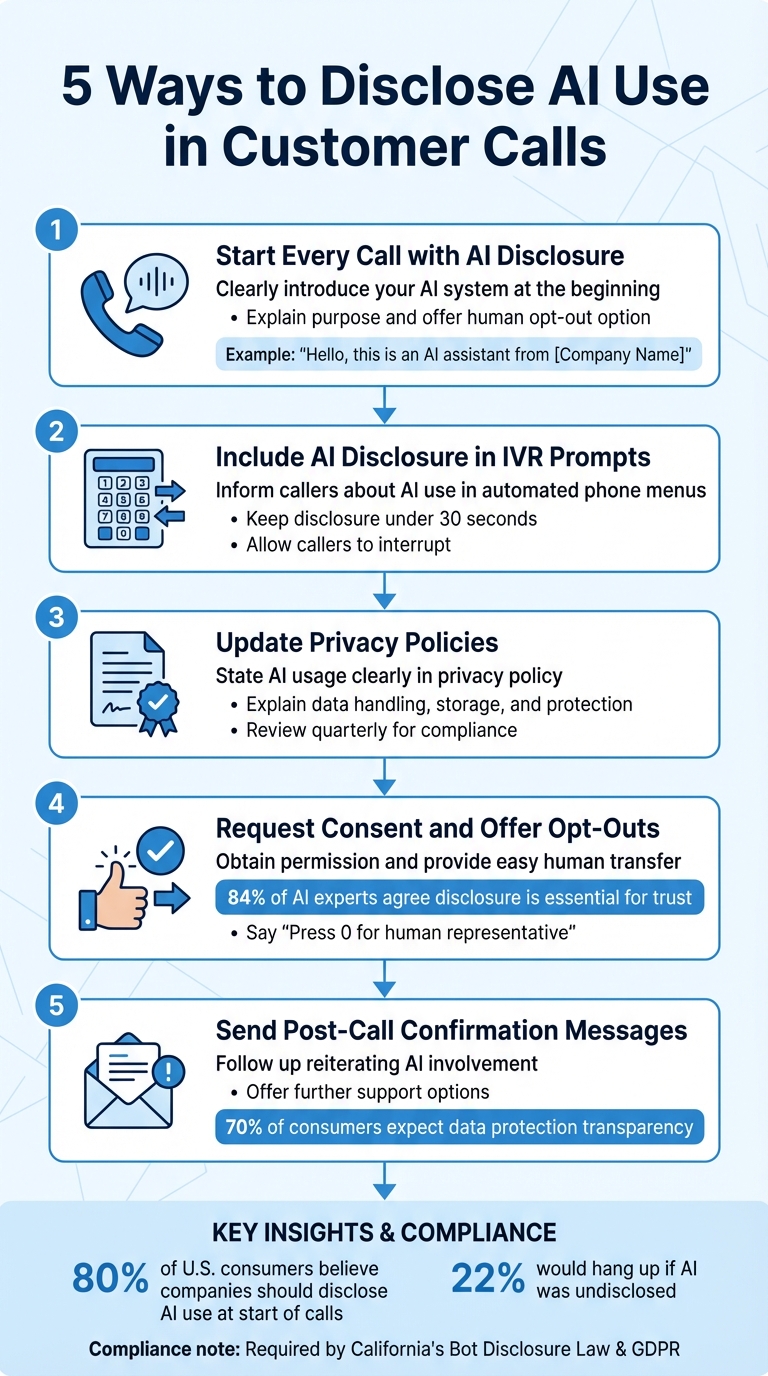
- Start Every Call with AI Disclosure: Clearly introduce your AI system at the beginning of the call, explaining its purpose and offering a human opt-out option.
- Include AI Disclosure in IVR Prompts: Make sure your automated phone menus inform callers about AI use upfront.
- Update Privacy Policies: Clearly state AI usage in your privacy policy, including how data is handled, stored, and protected.
- Request Consent and Offer Opt-Outs: Obtain permission to use AI and provide an easy way for customers to switch to a human representative.
- Send Post-Call Confirmation Messages: Follow up with a message that reiterates AI involvement and offers further support options.
These steps not only help you comply with laws like California's Bot Disclosure Law and GDPR but also build customer trust and reduce legal risks. Transparency is no longer optional - it's a necessity.
5 Steps to Disclose AI Use in Customer Calls
1. Disclose AI at the Start of the Call
Start every call by identifying your AI system. It’s not just about building trust - it’s also about meeting legal requirements. For example, regulations like California's Bot Disclosure Law demand immediate transparency about whether the caller is human or an AI system [1]. Delaying this disclosure can come across as misleading and may even breach these laws. A clear introduction ensures customers know who - or what - they’re interacting with from the very beginning.
Use straightforward terms like "AI assistant" or "artificial intelligence system" to avoid confusion and show respect for your audience. For instance, a healthcare provider might open with, "Hello, this is an AI assistant from Riverside Clinic calling to remind you about your 2:00 PM appointment." Similarly, a retail business could say, "Hi, this is an artificial intelligence system from Parker's Store calling about your recent order. Press 0 anytime to speak with a human representative."
Once you’ve disclosed the AI, explain the purpose of the call. Combining transparency with context helps customers quickly grasp the situation and decide how to engage. For example, a financial institution might say: "Good morning, this is an AI assistant from Valley Bank. I'm calling regarding your account... Press 0 anytime to reach a human banker." Including a human opt-out option early in the call can make the interaction feel more flexible and customer-friendly. Following AI to human handoff best practices ensures this transition is seamless for the caller.
Platforms like Dialzara make it simple to customize these AI disclosure greetings for various industries, whether it’s healthcare, legal services, real estate, or banking. Adjusting the tone to fit your field is key - think professional and compassionate for healthcare or security-conscious for financial services. Regularly updating your business phone scripts, ideally every quarter, ensures compliance with changing regulations [1].
For a friendlier touch, try blending the disclosure naturally into the conversation. For example, "I'm part of Metro Dental's digital team - how can I assist you today?" This approach keeps the interaction transparent while maintaining a welcoming and efficient tone.
sbb-itb-ef0082b
2. Add AI Disclosure to IVR Prompts
Just like with initial call disclosures, ensuring regulatory compliance extends to your Interactive Voice Response (IVR) system. Since the IVR system is often the first interaction callers have, it’s the perfect place to include an AI disclosure. Interestingly, research shows that 24% of callers express frustration with the time it takes to navigate automated systems [2]. To address this, your disclosure should be brief and sound natural while following specific timing guidelines.
Stick to the 30-second rule: The welcome message, including the AI disclosure, should not exceed 30 seconds [2]. For instance, a real estate agency might use this script:
"Hello, you've reached Riverside Realty. This is an AI system that can schedule viewings or connect you with an agent. Press 1 to book a showing, or press 0 to speak with a person."
This example not only introduces the AI clearly but also explains its purpose and offers a straightforward way to connect with a human.
Another key tip: allow callers to interrupt. Frequent callers may want to skip the disclosure and go straight to their desired option [2]. This saves time and ensures a smoother experience while still meeting compliance standards. Avoid vague terms like "automated system" or "virtual assistant." Instead, use specific phrases like "AI assistant" or "artificial intelligence system" to maintain transparency.
"An automated self-service system should provide the information to the customer in a clear, concise, and quick (CCQ) manner or transfer them so they can speak to an agent." – TTEC [2]
To make this process easier, tools like Dialzara offer customizable IVR solutions tailored to different industries. For example, a banking IVR might sound formal and security-focused, while a hospitality IVR could be warm and inviting. Additionally, ensure your scripts are reviewed and updated at least every quarter to stay aligned with changing regulations [2].
3. Update Privacy Policies to Include AI Use
Updating your privacy policy is a crucial step in maintaining transparency during customer interactions, especially when AI is involved. Legally, your policy must clearly disclose the use of artificial intelligence in customer calls. For instance, California's Bot Disclosure Law and GDPR regulations require businesses to explicitly identify AI systems in their documentation. The Federal Trade Commission also keeps a close eye on AI communication, expecting businesses to be upfront about automated systems [1].
Use straightforward language like "AI assistant" in your policy. Clearly define the AI's functions, such as AI appointment scheduling tools or handling billing inquiries, to set proper expectations. For example, a healthcare provider might include: "We use an AI assistant to schedule appointments, answer billing questions, and forward urgent calls to medical staff." This leaves no room for confusion about the AI's role.
It’s equally important to outline how data is handled. Explain how voice data is processed, stored, and secured, especially for industries like healthcare or finance where data sensitivity is paramount. Let customers know their rights - for example, under GDPR, they should be able to opt for human interaction if they prefer.
"Your scripts must explain data processing clearly." – PreCallAI [1]
Avoid burying this information in complex legal jargon. Keep the language simple and accessible so customers can understand it. Regularly review and update your policy to stay compliant with evolving AI regulations. Document all updates and AI-related activities to safeguard your business during regulatory reviews.
Lastly, make your privacy policy easy to find. Add links to your website footer, include it in onboarding emails, and mention it during the initial AI interaction. If you're using tools like Dialzara, you can even customize your AI assistant's greeting to direct customers to your full privacy policy, ensuring transparency from the start.
4. Request Consent and Offer an Opt-Out
Getting permission before using AI assistance isn’t just good practice - it’s the law. For example, California's Bolstering Online Transparency Act (Cal. BOTA) requires companies to disclose automated interactions and avoid misleading consumers about AI use [3].
Start your calls with straightforward communication, such as:
"Hello, this is an AI assistant from [Company]. May I help you, or would you prefer to speak with a human representative?"
This kind of transparency helps set clear expectations and gives customers control over their experience. In fact, 84% of AI experts agree that disclosing AI use is essential for maintaining trust [4].
Beyond the initial disclosure, always provide an easy way for customers to opt out of AI interactions. For example, your AI assistant could say:
"If you'd like to speak with a human, just say 'human' or press 0."
Make sure these transfers happen quickly and without unnecessary hurdles. Smooth transitions to a human representative help build trust and prevent customer frustration.
Additionally, keep a record of every consent and opt-out decision. This not only ensures compliance with regulations but also reinforces trust by demonstrating accountability [3].
Tools like Dialzara let you tailor your AI scripts to include consent prompts and enable instant transfers for customers who prefer human support.
"You're chatting with our AI assistant, who can help with most questions and connect you to a human if needed." – Kustomer [4]
5. Send Post-Call Confirmation Messages
After a call, sending a follow-up message is a great way to reinforce transparency and your dedication to clear communication. These post-call confirmations not only remind customers about AI involvement but also help document compliance with legal standards, which can strengthen trust.
Make it clear that an AI assistant handled the call by using direct terms like "AI assistant" or "artificial intelligence system" [1]. For instance, a follow-up text could say:
"Thank you for calling [Company Name]. Your request was managed by our AI assistant and has been logged for prompt follow-up. If you have any questions, please call [number] to speak with our team."
You can also take this opportunity to emphasize the advantages of AI, such as faster responses, consistent service, and accurate handling of requests [7]. This is especially important because nearly 70% of consumers consider safeguarding customer data a fundamental expectation from businesses [6]. Transparent communication about how their data is handled can go a long way in meeting this expectation.
Additionally, remind customers that they always have the option to speak with a human and manage their data under privacy regulations like GDPR or CCPA. Reinforcing this choice ensures customers feel in control and valued, which can help maintain loyalty and protect your brand's reputation.
Tools such as Dialzara can streamline these follow-up messages, ensuring that transparency and compliance are consistently upheld.
Conclusion
Being upfront about AI use fosters transparency and trust. Nearly 80% of U.S. consumers believe companies should disclose AI use at the start of customer service calls, and 40% are more likely to trust businesses that are transparent about their AI systems [8]. When customers know they're speaking to an AI assistant, it sets the right expectations and shows respect for their experience.
Regulations are catching up, too. California's Bolstering Online Transparency Act already bans misleading consumers about automated interactions, and similar laws are likely on the way [5]. The five strategies discussed - starting calls with clear AI disclosure, updating IVR prompts, revising privacy policies, offering opt-outs, and sending post-call confirmations - provide a straightforward framework for boosting transparency. These steps not only build customer confidence but also help your business stay compliant.
Tools like Dialzara make compliance easier. This system simplifies AI integration by automating disclosure processes, integrating with over 5,000 applications for consent tracking, and sending follow-up messages. It can reduce costs by up to 90% compared to traditional staffing while adapting quickly to your business needs and communication style.
The numbers highlight the stakes: 22% of consumers would hang up if they realized they were interacting with an undisclosed AI [8]. By adopting these methods now, your business can stand out as trustworthy and avoid losing customers. Start small - whether it's revising your call greeting or tweaking your privacy policy - and build from there. Your efforts will pay off in stronger customer loyalty and a reputation for transparency.
FAQs
Do I need to disclose AI use on both inbound and outbound calls?
AI disclosures are necessary for both inbound and outbound calls to ensure transparency and adhere to legal standards. Informing customers about the use of AI in their interactions helps build trust while keeping the process compliant with regulations.
What’s the simplest AI disclosure script that stays compliant?
The easiest way to ensure transparency when using AI in interactions is by plainly stating that AI is involved. For instance, you could say, "This call is being handled by an AI support system" or "Our AI system is assisting with this call." This straightforward approach not only meets regulatory requirements but also helps maintain trust with customers.
How should I record customer consent and AI opt-outs?
When engaging with customers, it's crucial to address consent upfront. Start by informing them at the beginning of the call about two key points: the involvement of AI and the recording of the conversation. Make sure to obtain their explicit agreement before proceeding.
For customers who wish to opt out of AI usage, it's important to provide clear and accessible options. This includes:
- Transparent data policies: Clearly explain how their data will be used, stored, or processed.
- Data access and deletion options: Allow customers to review or request the removal of their data if they choose.
- Error reporting and correction: Set up feedback mechanisms so customers can report inaccuracies or issues, ensuring errors are promptly addressed.
By prioritizing open communication and respecting customer preferences, you can build trust while staying compliant with legal and ethical standards.
Summarize with AI
Related Posts
Call Agent AI: Privacy Risks by Industry
Privacy threats from AI call agents in healthcare, legal, and finance — unintended data capture, voice biometrics, regulatory exposure, and mitigation steps.
FTC Rules for AI Chatbots: What to Know
Understand the FTC rules for AI chatbots, focusing on transparency, data protection, and compliance to safeguard consumer trust.
7 Disadvantages of AI in Customer Service (And How to Avoid Them)
Explore the top 7 AI risks in customer service and effective strategies to mitigate them for improved efficiency and customer satisfaction.
AI Customer Service: Balancing Privacy & Innovation
Explore the intersection of AI customer service and privacy, uncovering the benefits, risks, and strategies for ethical AI implementation and customer data protection.