
Top TCPA Risks for AI Phone Systems
Protect your business from $500-$1,500 per-call penalties with these essential compliance strategies for AI-powered phone systems.

Written by
Adam Stewart
Key Points
- Get company-specific consent starting January 2025 - blanket agreements won't work
- Use real-time DNC scrubbing instead of outdated batch methods
- Connect AI systems directly to your CRM for instant consent verification
- Document all consent with timestamps to avoid $50M+ lawsuit risks
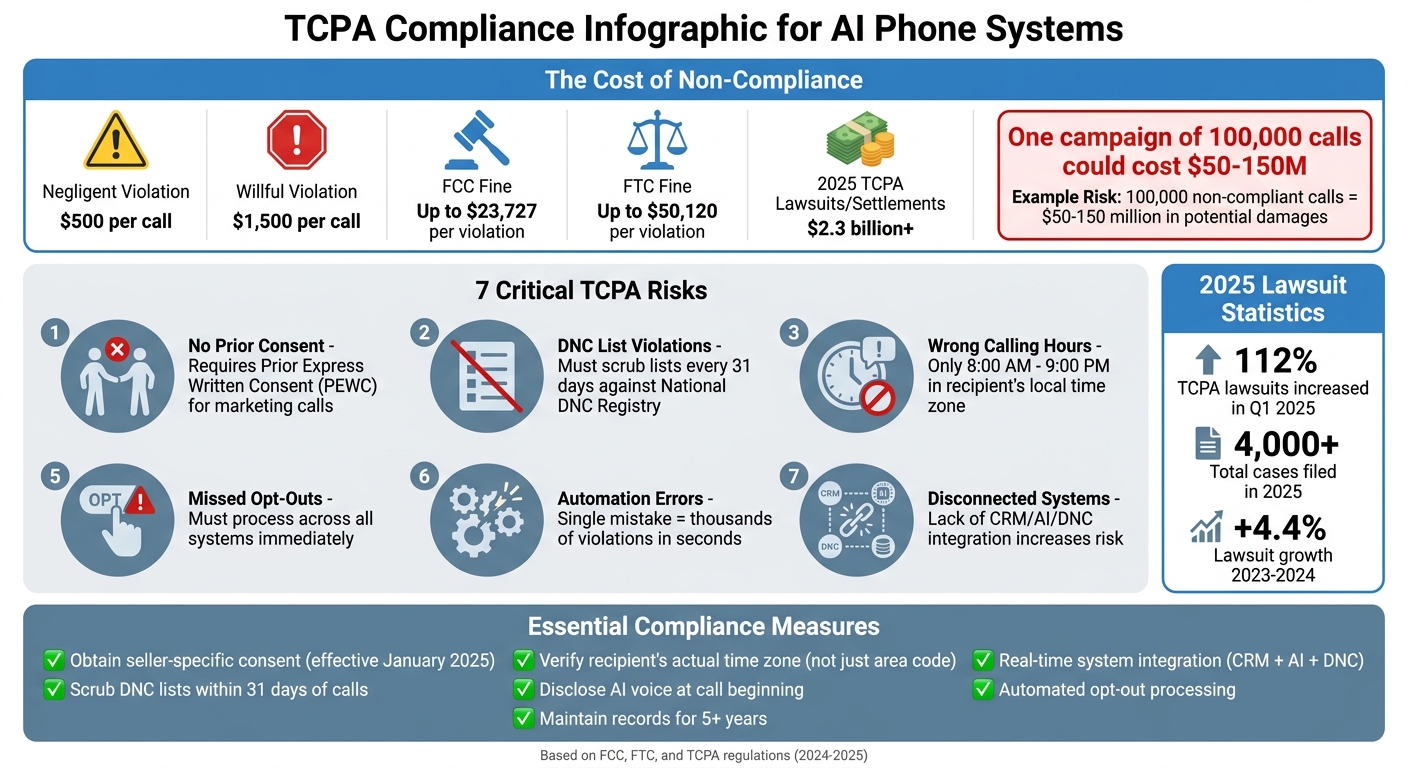
AI phone systems can streamline communication, but they come with serious TCPA compliance risks. Violations can result in fines ranging from $500 to $1,500 per call, and lawsuits are on the rise. Here’s what you need to know to avoid costly penalties:
- Consent is key: Marketing calls require Prior Express Written Consent (PEWC), and starting in 2025, consent must be specific to your company.
- Do Not Call (DNC) rules: Regularly scrub contact lists against the National DNC Registry and maintain an internal DNC list. Even accidental violations can be costly.
- Time restrictions: Calls are only allowed between 8:00 AM and 9:00 PM in the recipient's local time zone. Area codes alone may not reflect actual time zones.
- AI disclosure: AI-generated voices must be disclosed at the start of every call.
- Opt-out requests: Failing to process opt-outs across all systems can lead to repeated violations.
- Automation errors: Misconfigured AI systems can multiply mistakes, leading to thousands of violations in seconds.
- Disconnected systems: Lack of integration between AI platforms, CRMs, and compliance tools increases risk.
Key takeaway: TCPA compliance isn’t optional. Businesses must implement real-time consent verification, DNC scrubbing, and strict record management. Integrating compliance protocols into AI systems minimizes risks and protects against lawsuits.
TCPA Violation Penalties and Compliance Requirements for AI Phone Systems
1. Making Calls Without Prior Express Consent
TCPA Compliance Requirements
Under the FCC's interpretation, AI-generated voices are treated as "artificial or prerecorded voices" under the TCPA [2][4]. For marketing calls, businesses must secure Prior Express Written Consent (PEWC). This involves obtaining a signed agreement - electronic signatures are acceptable - that explicitly names your company, clarifies the use of AI or prerecorded voices, and states that giving consent is not tied to making a purchase [2][7]. For non-marketing calls, such as appointment reminders or delivery updates, Prior Express Consent (PEC) is sufficient [2].
Starting January 2025, the FCC introduced a "one-to-one consent" rule. This means consumers must give consent specifically to a named seller, making blanket agreements for "marketing partners" or "affiliates" invalid [1][6]. If your business relies on third-party leads, ensure that your company name is explicitly listed on the original consent documentation.
Risk Mitigation Strategies
To protect your business, maintain detailed records of consent. This includes:
- Timestamped screenshots of the consent form
- Exact wording of the disclosure
- The signature, along with the date and time
- IP address and source URL
- The seller's name
Keep these records for at least five years from the last point of contact [1][5].
Avoid fully relying on third-party lead vendors, as any violations can lead to severe penalties. Always verify that the leads you acquire have the necessary consents before making any calls.
Integration with AI Systems
Modern AI phone systems can integrate directly with your CRM to confirm consent status in real time before placing a call [2][4]. Set up automated checks to ensure that all calls are backed by valid and unrevoked consent.
Consumers can revoke their consent at any time by instructing an AI agent to "stop" or by replying with "STOP" [1][6]. Your system should immediately process these revocations across all communication channels. AI platforms can be programmed to reliably detect opt-out language, ensuring compliance and reducing risk. This kind of proactive consent verification strengthens your overall TCPA compliance efforts.
sbb-itb-ef0082b
2. Calling Numbers on Do Not Call Lists
TCPA Compliance Requirements
When it comes to compliance with the Telephone Consumer Protection Act (TCPA), businesses must ensure they aren't contacting numbers listed on Do Not Call (DNC) registries. The Federal Trade Commission (FTC) mandates that businesses check their contact lists against the National DNC Registry at least every 31 days to maintain a "safe harbor" defense [1][8]. This process, known as scrubbing, is non-negotiable. Even accidental violations can cost $500 per call [8]. And with the Federal Communications Commission (FCC) classifying AI-generated voices under the same rules as traditional robocalls starting in 2024, staying compliant is more important than ever [8][4].
Compliance involves a two-step process:
- Regularly checking the National DNC Registry.
- Maintaining an internal DNC list that includes numbers where individuals have explicitly requested no further contact. These lists need to sync across all systems - whether it's your dialers, CRM, or AI platforms [1][4][5].
While accessing the National DNC Registry costs $88 per area code annually, this expense pales in comparison to the cost-benefit analysis of AI phone agents and potential damages. For instance, a single campaign of 100,000 calls could result in statutory damages ranging from $50 million to $150 million if violations occur [5][8].
Risk Mitigation Strategies
To minimize risk, businesses should replace outdated batch scrubbing methods with real-time API lookups. These tools verify numbers against National, state, and internal DNC lists immediately before each call [1][5]. This approach ensures that your data is always current, reducing the chance of unintentional violations.
Additionally, train your AI systems to recognize opt-out phrases like "don’t call me again" and automatically update the consumer’s status across all platforms [4]. Keeping detailed logs of these updates is also essential to meet regulatory requirements [5][8].
Integration with AI Systems
For seamless compliance, ensure your AI phone agents are directly connected to your CRM. This integration prevents calls to contacts flagged with opt-out or DNC statuses [4]. If a consumer opts out, all systems should update instantly. A notable example is Wyndham Destinations, which in October 2025 implemented automated DNC screening technology. This type of AI call screening is a critical component of modern compliance. This system blocked restricted numbers in real-time across both internal and third-party platforms, helping them avoid hefty fines [9].
Such integrations strengthen your compliance efforts and reduce legal and financial risks.
| Violation Type | Penalty Range | Enforcement Agency |
|---|---|---|
| DNC Registry Violation | $500–$1,500 per call | Private, FTC, or FCC |
| Negligent TCPA Violation | $500 per call | Private litigation |
| Willful TCPA Violation | $1,500 per call | Private litigation |
| TSR Violation (FTC) | Up to $50,120 per violation | FTC |
Lastly, remember that some states, like Florida, Oklahoma, and Washington, enforce stricter DNC rules than federal standards [8]. Your AI systems must account for these state-specific requirements to ensure full compliance across all regions.
3. Calling Outside Permitted Hours
TCPA Compliance Requirements
Time restrictions for telemarketing calls are a major area of concern when it comes to TCPA compliance. According to the TCPA, telemarketing calls are only allowed between 8:00 AM and 9:00 PM in the recipient's local time zone [1]. This rule also applies to calls made by AI systems, as the FCC categorizes AI-generated voices as "artificial or prerecorded" [2].
For nationwide campaigns, it's essential to determine the recipient's actual time zone, as area codes can be misleading. For example, a person might keep their California area code even after moving to New York due to number portability [1]. Additionally, more than 30 states have their own telemarketing laws, and some impose even stricter time restrictions than federal guidelines [1]. Florida's Telephone Solicitation Act, for instance, imposes penalties of $1,500 per call for willful violations [7].
The costs of non-compliance can be steep. Negligent violations can result in statutory damages of $500 per call, while willful violations may lead to penalties of $1,500 per call [1]. On top of that, the FCC can issue fines of up to $23,727 per violation, and the FTC can impose penalties as high as $50,120 under the Telemarketing Sales Rule. In 2025 alone, TCPA-related lawsuits and settlements surpassed $2.3 billion [7].
Risk Mitigation Strategies
To reduce these risks, configure your AI dialer to block calls outside the 8:00 AM to 9:00 PM window based on the recipient's local time [1]. Use updated CRM location data to verify time zones instead of relying solely on area codes. If state laws impose stricter limits than federal regulations, ensure your system follows the most restrictive rule [1].
"Your system needs to apply the most restrictive applicable rule for each consumer's location." – LeadCompliant [1]
Another important step is keeping detailed audit logs that record the timestamp and calculated time zone for every call attempt. These logs can serve as critical evidence if your compliance practices are ever questioned [2].
Integration with AI Systems
AI systems excel at consistently enforcing quiet hours, a task that human callers might occasionally overlook. However, a single configuration error in an AI system can result in thousands of non-compliant calls within seconds, creating significant legal risks [1]. To avoid this, integrate your AI phone agent with your CRM to use real-time location data instead of relying solely on area codes.
"AI systems that call nationwide must automatically adjust to different time zones. Otherwise, they can violate TCPA rules." – Simon Harris, OneAI [4]
For businesses using AI platforms like Dialzara, syncing with a CRM ensures access to accurate customer location data. This integration allows the system to automatically block calls during restricted hours, complying with both federal and state regulations across all 50 states. This proactive approach minimizes the risk of violations while maintaining compliance.
4. Not Disclosing AI-Generated Voices
TCPA Compliance Requirements
In February 2024, the FCC issued a Declaratory Ruling that clarified an important point: AI-generated voices are considered "artificial or prerecorded voices" under the TCPA [10][4][3]. This means that AI-driven phone systems are held to the same stringent rules as traditional robocalls.
"The FCC has gone so far as to establish that AI-generated voices fall squarely within the TCPA's restrictions, which creates significant liability for non-disclosure." – Hannah L. Sfameni, Senior Associate & Director of Compliance, DarrowEverett [10]
To comply, every outbound AI call must include a disclosure that clearly identifies the business, states the use of AI, and provides a callback option [10][4][3]. For marketing calls to mobile phones, businesses must also secure prior express written consent, explicitly mentioning the use of AI-generated communications [4][1].
The financial risks for non-compliance are steep. In 2024, the FCC proposed a $299 million fine against an insurance lead generator for making millions of calls using prerecorded AI voices to numbers on the DNC registry [7]. That same year, a political robocaller faced a $6 million penalty and a criminal referral for impersonating a political candidate with AI-generated voices [7].
Risk Mitigation Strategies
To stay compliant, start every AI call with a clear and upfront introduction. For example: "Hi, this is ABC Company's AI assistant calling about your recent inquiry." This kind of disclosure is essential [2][4].
Make sure all consent forms are updated to include explicit language about AI-generated communications [10]. Consumers must understand that they may receive calls using AI voice technology. Train your team to answer questions about the use of AI in a straightforward and transparent way, which helps reinforce your compliance efforts [10].
Keep detailed records of every call, such as transcripts or recordings, to prove that disclosures were made. These records should be retained for at least five years, providing a safety net in case your practices are ever questioned [10][4].
Integration with AI Systems
Ensure your AI systems are programmed to disclose their AI nature and the business identity at the start of every call. If you’re using platforms like Dialzara, configure the AI agent's script to include the business name and purpose of the call in the opening greeting.
Additionally, use natural language processing to allow your AI agent to recognize and respond to verbal opt-out requests - even if the consumer doesn’t use specific keywords [4].
"If an AI is generating the voice on a call, it is treated as an artificial or prerecorded voice under the TCPA. This means AI voice agents must follow all TCPA rules. No exceptions." – Simon Harris, OneAI [4]
5. Missing Opt-Out Requests and Poor Record Management
TCPA Compliance Requirements
Building on earlier TCPA challenges, failing to properly update opt-out records or manage call logs can significantly increase liability. This makes thorough record management a critical part of compliance. It's essential to retain all relevant records - such as consent forms, call logs, and opt-out events - for at least five years [5].
Consumers can revoke consent in various ways, including voice commands, texting 'STOP,' email, or even through social media. Once an opt-out request is made, it must be reflected across all connected systems - like dialers, CRMs, internal DNC lists, and any affiliated operations - without delay [5].
"If the consumer receives another call because the opt-out was not properly propagated, that is a separate TCPA violation." – LeadCompliant Team [5]
To build a defensible consent record, include the following details: a timestamped screenshot of the form as seen by the consumer, the exact disclosure language, the consumer's electronic signature, the precise date and time, the IP address, and the source URL [5]. Call logs should document every outbound attempt, including the timestamp, the system used to initiate the call, call duration, and the outcome - especially if an opt-out was requested [5].
The cost of TCPA violations can be steep, with statutory damages of $500 per call, increasing to $1,500 per call for intentional violations [4]. In 2025, a debt collection agency incurred a $45 million penalty for contacting consumers after they had revoked consent. That same year, TCPA-related lawsuits and settlements in the U.S. surpassed $2.3 billion [7].
Risk Mitigation Strategies
To avoid violations, managing opt-out requests and records should be a proactive and system-wide effort.
Opt-outs can't be treated as isolated events - they must trigger immediate updates across all systems. Configure your AI systems to recognize opt-out phrases like "remove me from your list" and automatically add those numbers to your internal DNC list. Real-time API lookups can also cross-check numbers against relevant DNC registries [4][5].
"Documentation is the backbone of any defensible compliance program for AI-generated calls." – LeadCompliant Team [5]
The FTC mandates that data from the National DNC Registry be refreshed at least every 31 days for telemarketing calls to qualify for safe harbor protection [5]. Securely store all compliance records to maintain a verifiable audit trail in case of litigation or regulatory scrutiny [5]. Additionally, ensure your CRM and dialer systems are bi-directionally synced so that any opt-out flagged by your AI system immediately updates the corresponding contact record, preventing future automated calls [4].
Integration with AI Systems
Integrating opt-out protocols and record management with AI systems is key to ensuring consistent TCPA compliance across all channels.
For example, if you're using an AI phone system like Dialzara, make sure it's directly connected to your CRM. This allows opt-out requests to be processed immediately and logs each revocation with details like the method used, date, and time, ensuring a clear audit trail [5][7]. The system should automatically exclude flagged numbers from all future campaigns, ideally within 24 hours, aligning with recent FCC recommendations [7].
| Record Type | Required Data Points | Retention Period |
|---|---|---|
| Consent Records | Timestamped screenshot, disclosure text, IP address, source URL, E-signature | 5 Years |
| DNC Scrub Logs | Date of scrub, registry vintage, phone numbers checked, match actions | 5 Years |
| Call Logs | Timestamp, initiating system ID, duration, disposition, opt-out flags | 5 Years |
| Opt-Out Logs | Method of revocation (voice/text/IVR), date/time, confirmation sent | 5 Years |
Proper record management not only helps you avoid costly penalties but also strengthens the overall integrity of your TCPA compliance efforts.
6. Multiplying Errors Through Automation
TCPA Compliance Requirements
Automation can be a double-edged sword when it comes to TCPA compliance. While it can streamline processes, errors in configuration can lead to massive risks. A single mistake in an AI system can quickly snowball into thousands of TCPA violations. For example, the FCC's February 2024 Declaratory Ruling (FCC 24-17) classified AI-generated voices as "artificial or prerecorded", meaning they now fall under the TCPA's strictest consent requirements - even if they sound completely human-like [1][11].
Some of the most common automation failures include issues like outdated consent data, DNC filter errors, and incorrect time-zone logic. For instance, systems relying on a one-time batch scrub at the start of a campaign lose their safe harbor defense if the campaign extends beyond the FTC's required 31-day refresh window [1]. Similarly, dialers that base calling windows on area codes alone often overlook number portability, leading to calls outside the permitted 8:00 AM to 9:00 PM local time window [1].
"Manual compliance processes break down quickly when you are handling thousands or tens of thousands of leads and calls per day." – LeadCompliant Team [1]
The consequences of these errors are severe. TCPA penalties range from $500 per negligent violation to $1,500 for willful violations [1]. In 2025 alone, TCPA-related lawsuits and settlements topped $2.3 billion, with class action filings increasing by 112% in Q1 of that year [11]. These staggering figures highlight the need for robust, real-time compliance measures.
Risk Mitigation Strategies
To prevent automation-related compliance failures, businesses must shift from outdated batch processes to real-time checks. For instance, API-based lookups against the National DNC, state-specific lists, and litigator databases should be performed before each call. ZIP code mapping, rather than relying solely on area codes, ensures compliance with local calling hours [1]. Additionally, setting a hard limit of 2% on abandoned calls helps maintain compliance with the 3% legal maximum [11].
Consent verification can also be automated by ensuring each lead's record includes the required disclosure language, timestamp, and associated details before entering the dialing queue [1]. Centralizing suppression lists is another critical step - this ensures that opt-outs are immediately applied to the master dial list, reducing the risk of non-compliance [2].
"If your AI phone strategy is not TCPA-compliant, it is not scalable. It is risky." – Simon Harris, OneAI [4]
For states with stricter rules, such as Florida and Oklahoma (prohibiting calls after 8:00 PM) or Indiana (restricting calls before 9:00 AM), automated rules can enforce these specific time constraints [11]. Regular audits of campaign dial lists are also essential to ensure that Do Not Call dispositions are promptly updated and removed from active queues [11].
Integration with AI Systems
Integrating compliance protocols directly into AI systems is another way to reinforce adherence to TCPA regulations. For instance, when using AI phone systems like Dialzara, syncing with CRM systems ensures that National DNC numbers, internal DNC entries, and real-time opt-outs are immediately suppressed [4]. AI agents equipped with advanced natural language processing (NLP) can recognize and honor verbal opt-out requests. These requests should include the seven mandatory FCC keywords: stop, quit, revoke, opt out, cancel, unsubscribe, and end [11].
In cases where a call disconnects, businesses should play a prerecorded message within two seconds to identify the company and offer a callback option [11]. Maintaining tamper-proof logs of every consent verification, DNC scrub, and opt-out event for at least five years is another critical step to ensure a defensible position in case of litigation [7].
"The regulatory landscape shifted more between 2024 and 2026 than it did in the previous decade." – Jason Shouldice, Owner of vicistack.com [11]
7. Managing Multiple Disconnected Systems
TCPA Compliance Requirements
When AI phone systems operate separately from your CRM, DNC lists, and consent databases, compliance risks grow significantly. For example, if a customer requests to "stop" communications and that update doesn't reach all systems, you're left vulnerable. Under TCPA rules, businesses have 10 business days to honor such requests [3]. Additionally, internal DNC requests must comply with specific record-keeping requirements [7].
The FCC's one-to-one consent rule, coming into effect on January 27, 2025, adds another layer. This rule mandates seller-specific consent [1][7]. If your AI system relies on outdated CRM data, it risks contacting individuals whose consent has expired or been revoked. Moreover, the FTC requires companies to access National DNC Registry data no more than 31 days before making calls [1][5]. If you're relying on monthly batch updates, you could miss critical changes, jeopardizing your safe harbor defense.
| System Component | Risk if Disconnected | Compliance Requirement |
|---|---|---|
| CRM & AI Dialer | Calls persist after CRM opt-out updates | Real-time sync of opt-out flags |
| DNC Registry & Dialer | Calls to numbers added after last scrub | Scrubbing within 31 days of the call |
| Lead Source & Dialer | Calls without verified one-to-one consent | Verification of seller-specific disclosure |
| Internal DNC List | Missed "stop" requests across departments | Centralized internal DNC suppression |
"The legal liability falls on the company that made the call, not the company that generated the lead." – LeadCompliant [1][5]
These examples highlight the importance of integrating systems to ensure that opt-out requests are updated promptly and consistently.
Risk Mitigation Strategies
Disconnected systems don't just create inefficiencies - they can directly lead to compliance failures. To avoid this, centralizing your compliance infrastructure is key. When a customer revokes consent - whether through an AI agent, IVR, text message, or a live representative - the update should immediately reflect in a master suppression list shared across all systems [1][4]. Relying on manual updates between systems introduces delays, increasing the risk of unauthorized calls.
Modern compliance platforms address this by using API-based, real-time lookups. These platforms can check National, State, and internal DNC registries in milliseconds [1][5]. Additionally, maintaining a centralized, tamper-proof audit trail of all consent and opt-out events is crucial. This becomes especially important when defending against the thousands of TCPA lawsuits filed annually - 4,000 cases were reported in 2025 alone [7].
"If you think compliance is expensive, try non-compliance." – Paul McNulty, 32nd Deputy Attorney General of the United States [3]
Integration with AI Systems
AI phone systems, like Dialzara, can integrate directly with your CRM, ensuring that consent and opt-out data are synchronized across all systems in real time [4]. This means that when a customer opts out during a call, the update is instantly reflected in your master database, preventing any further contact. By eliminating manual processes, you can ensure compliance checks are seamlessly built into your workflow.
Time-zone synchronization is another critical element. Your AI system must automatically determine local time based on area codes and number portability to ensure calls are made during permitted hours - typically between 8:00 AM and 9:00 PM [1][4]. Systems that rely solely on area codes for time zones risk violating state-specific regulations [7]. To stay ahead, conducting quarterly audits of your integrated systems can help identify and resolve configuration issues before they lead to larger compliance problems.
Conclusion
The seven TCPA risks discussed earlier are not hypothetical - they’re very real. Just one campaign involving 100,000 non-compliant calls could result in damages ranging from $50–$150 million. With per-call fines reaching up to $23,727 (FCC) and $50,120 (FTC), the stakes are incredibly high [1][5].
This highlights why robust, automated compliance measures are so critical. Properly configured AI phone systems can lower compliance risks. Unlike human agents who might overlook disclosures or fail to process opt-out requests, AI systems can be programmed to consistently meet legal requirements. They ensure disclosures are delivered, adhere to approved calling hours (8:00 AM to 9:00 PM local time), and handle opt-out requests immediately [4]. Tools like Dialzara integrate seamlessly with CRMs and compliance systems, reducing the likelihood of errors and non-compliance.
However, technology alone isn’t enough. Legal oversight is equally important. Tyler Weitzman, Co-Founder & Head of AI at Speechify, emphasizes this point:
"The critical path is compliance setup (TCPA, A2P 10DLC, number verification), not technology. The voice AI itself can be configured in a week" [2].
Collaborating with legal experts who understand evolving regulations - such as the 2024 FCC one-to-one consent rule and the classification of AI-generated voices as "artificial or prerecorded" - is essential [1][2]. These professionals can help navigate federal and state-level "mini-TCPA" statutes to ensure your strategies remain compliant.
The financial risks of non-compliance are growing. Between 2023 and 2024, TCPA lawsuits rose by 4.4%, with plaintiff attorneys now leveraging automated complaint systems and call-tracing technology to identify violations [3][5]. To scale AI phone operations safely, combine legal counsel with automated compliance tools. Make sure to verify lead consent chains, perform real-time scrubbing at least every 31 days, and maintain detailed records for at least five years from the last contact date [1][5].
FAQs
What counts as valid consent for AI marketing calls in 2025?
In 2025, businesses must secure prior express written consent (PEWC) for AI-driven marketing calls. This consent must include a clear disclosure about the use of AI voices. For non-marketing calls, prior express consent (PEC) is required, meaning consumers must explicitly authorize the communication. Additionally, companies are obligated to keep detailed records of all consents to stay compliant with TCPA rules.
How can I prove consent, disclosures, and opt-outs if I’m sued?
To ensure compliance and demonstrate consent, it's crucial to maintain detailed, tamper-proof records of all consumer interactions. This includes documenting explicit consent with precise time and date stamps, the disclosures provided (such as identifying AI involvement), and the opt-out processes followed.
Keep these records for a minimum of 5 years, and make it a habit to regularly cross-check your contact lists against the National Do Not Call Registry. Additionally, preserving call recordings, timestamps, and compliance logs is invaluable when defending against potential legal challenges. These steps not only help safeguard your operations but also build trust with consumers.
What real-time checks should my AI phone system perform before each call?
To meet TCPA requirements, your AI phone system should follow these key practices:
- Verify consent: Make sure you have valid, documented prior express consent from the recipient, and ensure it’s up-to-date. This step is crucial to avoid unintentional violations.
- Check Do Not Call (DNC) lists: Regularly scrub your call lists against the National Do Not Call Registry and your internal opt-out records. This helps prevent contacting individuals who have opted out.
- Disclose AI use: At the beginning of the call, clearly inform the recipient that they are speaking with an AI system. Transparency is essential for compliance.
- Monitor compliance: Review your call scripts frequently to ensure they meet TCPA standards. This includes avoiding restricted call times and providing clear opt-out options.
By sticking to these steps, you can safeguard your AI phone system against potential TCPA violations.
Summarize with AI
Related Posts
AI in Telemarketing: Legal Tips
Legal essentials for AI telemarketing: one-to-one consent, AI disclosure, DNC scrubbing, recordkeeping, and real-time compliance tools.
AI Call Agents vs. TCPA: Compliance Checklist
Checklist of TCPA rules for AI call agents: consent, time windows, ID, DNC scrubs, opt-outs, and five-year records.
Telemarketing Compliance Checklist for AI Systems
AI telemarketing checklist: obtain written consent, scrub DNC lists, disclose AI, respect call times, and process opt-outs immediately.
TCPA Compliance for AI: 5 Key Tips
AI voice calls face the same TCPA pitfalls as robocalls - secure clear consent, deliver disclosures, log calls, and audit to avoid costly fines.