

AI Social Listening for SMBs: Setup Guide
Turn social chatter into business insights with AI tools that find hidden mentions and track competitor moves for under $100/month.

Written by
Adam Stewart
Key Points
- Set SMART goals first to avoid data overwhelm and focus on actionable insights
- Choose platforms where your audience actually engages, not where you think they are
- Connect tools to your CRM and Slack to cut manual work by 50%
- Track untagged mentions to catch conversations you're missing completely
AI social listening helps your business understand what customers are saying online - even when they don’t tag your brand. It goes beyond basic social monitoring by analyzing sentiment, trends, and untagged mentions across platforms like Twitter, Facebook, Reddit, and more. For small and medium-sized businesses (SMBs), this can reveal hidden opportunities, track competitors, and help manage your reputation.
Key Takeaways:
- What it does: Tracks untagged mentions, analyzes sentiment, and identifies trends.
- Why it matters: Helps SMBs stay competitive, manage reputation, and discover leads.
- How to start: Define clear goals, choose the right tools, and set up alerts for relevant keywords.
Quick Example: Use AI tools to monitor phrases like "alternative to [Competitor]" to find potential customers looking for solutions your business offers.
The rest of this guide walks you through setting up AI social listening tools, connecting platforms, and using insights to improve customer service, marketing, and product development.
Preparing Your SMB for AI Social Listening
Before diving into AI-powered social listening, take a step back and define your goals. Without a clear purpose, you'll end up overwhelmed by data that lacks actionable insights. The difference between successful social listening and wasted effort lies in proper preparation. Start by identifying your objectives to shape your approach.
Setting Your Social Listening Goals
Set goals that align with your business priorities, using the SMART framework - Specific, Measurable, Achievable, Relevant, and Time-bound. This ensures your efforts are focused and measurable. For example:
- Reputation Management: Monitor both tagged and untagged mentions to catch potential crises early.
- Competitive Analysis: Track mentions of competitors and gauge sentiment to uncover their weaknesses and compare your brand's "share of voice."
- Lead Generation: Set up alerts to catch buyer intent signals, such as "Can anyone recommend...?" or complaints about competitors.
- Customer Experience: Identify pain points in the buyer journey to improve satisfaction.
- Product Development: Use unfiltered feedback to inspire updates or new features.
Instead of vague goals like "improve customer service", aim for something specific, such as: "Reduce negative sentiment by 15% within 90 days by responding to complaints within 2 hours." This approach keeps your efforts focused and measurable.
As Social Media Consultant Annie-Mai Hodge puts it:
"Monitoring tells you what people are saying to you. Listening reveals what they're saying about you." [3]
Choosing Which Platforms to Monitor
Your audience's preferred platforms should guide your efforts. For B2B brands, LinkedIn is ideal for professional networking and thought leadership. B2C brands targeting younger audiences might find TikTok and Instagram more effective. With 72% of U.S. adults active on social media [4], the real challenge isn’t finding conversations - it’s finding the right ones.
Don’t overlook niche platforms like Reddit, Discord, or industry-specific forums, where feedback is often candid and valuable. Study where your competitors get the most engagement to pinpoint key conversation hubs. To cut through the noise, use Boolean search operators (AND, OR, NOT) to refine your queries and focus on relevant topics. Once you’ve identified your target platforms, you can allocate your budget and choose the right tools to maximize efficiency.
Budget and Tool Requirements
Social listening tools vary widely in cost, typically based on the volume of mentions they track and the complexity of their analytics. Start by setting a clear budget and outlining the features you need. Essential capabilities often include sentiment analysis to uncover the "why" behind conversations, as well as insights into demographics, behavior, location, and language.
Choose tools that integrate smoothly into your existing systems. For example, look for options that provide real-time alerts via Slack or connect with your CRM for seamless lead management. Boolean search logic is another must-have for creating advanced queries that filter out irrelevant data. Take advantage of free trials (usually 7–14 days) to ensure the tool meets your specific needs. And if your social monitoring skills - like responding to direct tags - aren’t up to par yet, focus on mastering those basics before investing in more advanced listening tools.
Step-by-Step Setup Guide for AI Social Listening Tools
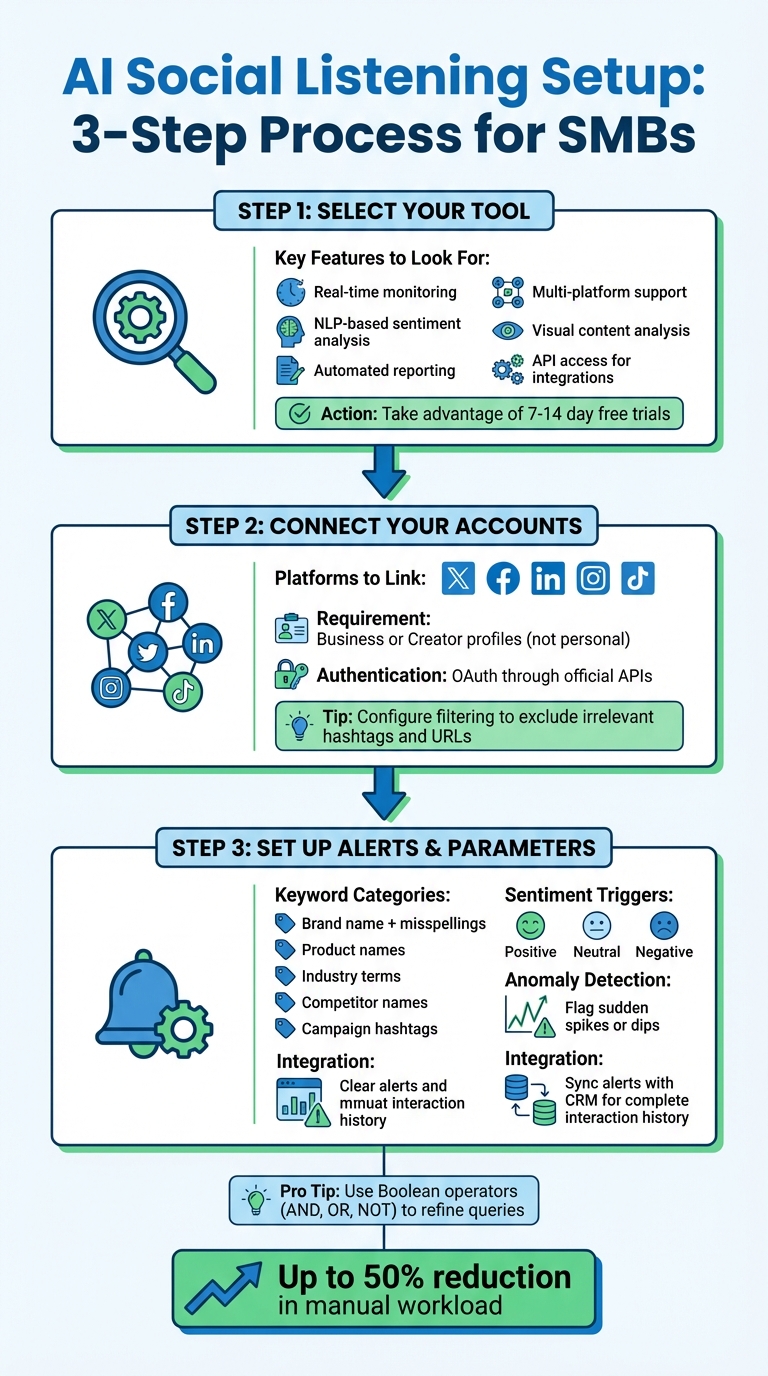
AI Social Listening Setup Process for Small Businesses
Set up your AI social listening system to reduce your manual workload by up to 50% [5].
Selecting an AI Social Listening Tool
When choosing an AI social listening tool, focus on features, pricing, and scalability [5]. Key functionalities to look for include real-time monitoring, NLP-based sentiment analysis, automated reporting, and support for multiple social platforms. Some advanced tools also offer visual content analysis, which can recognize your logo in images and videos - even if it isn’t tagged - along with predictive analytics to identify emerging trends [5]. If you need custom integrations, check for API access to connect with systems like Salesforce, HubSpot, Slack, or Microsoft Teams. Seamless integration ensures that social insights flow directly into your existing workflows. For instance, Dialzara offers quick setup and connects with over 5,000 business applications.
Take advantage of free trials to test the tool’s interface and confirm it meets your needs. Once you’ve made your choice, connect your social media accounts to create a unified data stream.
Connecting Your Social Media Accounts
Most AI social listening tools rely on OAuth authentication through official APIs like the Facebook Graph API or Twitter API. To connect your accounts, log in through the tool’s interface and grant permissions, such as access to mentions, public profile data, and, if applicable, comment management. Make sure your accounts are set as Business or Creator profiles, as personal accounts often have limited API access. Use the tool’s integration dashboard to link platforms like X, LinkedIn, TikTok, and Instagram, consolidating all your data in one place.
To improve the accuracy of sentiment analysis, configure filtering parameters to exclude irrelevant hashtags, URLs, or non-alphanumeric characters [6]. Maintain a social listening log to track findings, engagement levels, and next steps - whether it’s responding to customer feedback or amplifying user-generated content [7]. Filtering your data will ensure more precise insights.
Setting Up Alerts and Parameters
Build a keyword list that includes your brand name (and common misspellings), product names, industry-specific terms, competitor names, and campaign hashtags [5]. Many tools now offer "Smart Themes" or topic clustering, which automatically group related conversations, saving you time on manual tagging [2]. Use sentiment triggers to classify mentions as positive, negative, or neutral, and enable anomaly detection to flag sudden spikes or dips in activity. This is especially useful for catching potential crises early [2]. For example, you can configure alerts to activate only when a post hits a certain engagement threshold, helping you avoid low-priority distractions [5].
Sync these alerts with your CRM to maintain a complete interaction history. Clearly define which alerts require immediate escalation to PR or management teams and which can be handled by customer support [2][8]. This setup ensures you're ready to respond quickly when real-time monitoring uncovers issues that need urgent attention.
Getting the Most from AI Social Listening
Once your AI social listening system is in place, the next step is making those insights work for your business. This means learning how to interpret the data, linking it to your day-to-day operations, and fine-tuning your approach over time.
Analyzing Sentiment and Trends
AI-driven sentiment analysis helps categorize feedback into positive, negative, or neutral groups by scanning social media, reviews, and forums. Modern tools are smart enough to recognize context, sarcasm, emojis, and even industry-specific slang, which minimizes errors. For instance, if someone posts, "Yeah, great service" with an eye-roll emoji, the AI will pick up on the sarcasm and correctly flag it as negative.
Check your sentiment dashboard daily to spot trends early. A sudden surge in negative mentions? Don’t ignore it - it could signal a service issue or a product defect that needs immediate attention. On the flip side, identify loyal customers who frequently share positive feedback and use their testimonials to inspire your team or enhance training programs.
For service-based small businesses like salons or repair shops, sentiment analysis can also highlight standout employees or services. For example, if customers rave about a particular stylist’s communication skills, you can use that information to both improve internal practices and enhance your brand’s reputation.
Connecting with Customer Service and Marketing
After breaking down the sentiment data, the next step is integrating these insights into your customer service and marketing strategies. When paired with your CRM, social listening data creates a more complete view of each customer’s journey. This allows support agents to offer personalized service by referencing recent social media interactions.
Here’s how AI features can benefit small businesses:
| Feature | Benefit for SMBs |
|---|---|
| Real-Time Analysis | Address negative feedback quickly to prevent reputation issues. |
| Understanding Context | Decode sarcasm, emojis, and industry-specific language accurately. |
| CRM Integration | Equip support teams with a full picture of customer interactions. |
| Automated Routing | Direct urgent complaints to the right team while automating responses to positive feedback. |
Use AI to prioritize responses based on the intensity of feedback. For example, escalate high-intensity complaints to management for immediate action, while sending automated thank-you messages for positive mentions. Share those positive mentions with your marketing team - they can use them as social proof to boost campaigns.
Marketing teams can also use trend data to adapt campaigns on the fly. If AI detects a spike in conversations about a specific product feature or trending topic, adjust your messaging to ride that wave. For instance, if customers are raving about a particular dish at your restaurant, promote it heavily on social media and in email campaigns.
Improving Through Feedback Loops
Your AI social listening system isn’t a “set it and forget it” tool. It needs regular updates to stay effective. Start with a pilot period of two to three weeks to test your initial keywords and response protocols. Based on the results, tweak your settings. If the AI misses key conversations or flags irrelevant mentions, refine your keyword list and filters.
Track key performance metrics to ensure your system is delivering results. Aim for metrics like:
| Metric | Target | Action if Below Target |
|---|---|---|
| Resolution Rate | >80% | Update AI training data and keywords. |
| Response Time | <10 seconds | Streamline processing workflows. |
| CSAT Score | >4.5/5 | Improve response quality and tone. |
| Query Volume | Match capacity | Adjust staffing or scaling parameters. |
Recurring feedback can also inform product development. For example, if the AI identifies frequent complaints about setup difficulties or service delays, you can use that data to improve instruction manuals, adjust staffing, or redesign problematic features. Combining AI’s ability to prioritize data with human decision-making leads to more thoughtful solutions.
For a more comprehensive view of customer sentiment, consider integrating voice interaction data from AI phone systems like Dialzara. This lets you capture feedback from phone calls alongside social media data, giving you an omnichannel understanding of how your brand is perceived. Keep refining your approach to stay responsive to new trends and customer needs.
sbb-itb-ef0082b
Troubleshooting and Common Problems
Once you've fine-tuned your social listening setup, it's important to tackle common challenges that might interfere with data accuracy or disrupt workflows. Even the best AI-driven systems can hit a few snags, but most issues have straightforward solutions if you know where to start.
Fixing Data Integration Issues
Integration hiccups often happen when your social listening tool doesn’t connect properly with your CRM, marketing platforms, or other essential business systems. The first step? Double-check your API credentials - expired tokens or incorrect permissions are frequent troublemakers. If data isn’t flowing as expected, confirm that both platforms support the integration you're trying to establish. Consult your tool’s documentation to ensure compatibility and review the supported data fields. Testing each connection can help you zero in on the problem. Resolving these integration challenges is crucial to maintaining a steady flow of reliable insights.
Handling Incomplete or Inaccurate Data
Poor data quality can derail your insights entirely. If your AI relies on subpar data, the results will reflect that. A telling statistic: 75% of users believe AI often provides inaccurate answers [11], and traditional keyword-based searches can yield up to 90% irrelevant "noise" [10].
"AI is only as smart as the data behind it. So, getting the right data isn't just important, it's essential."
- Thrushna Matharasi, Director of Engineering, Solera Holdings [9]
To ensure better data quality, refine your keyword tracking. Update keyword maps to include common misspellings, regional slang, and evolving customer language. For example, a coffee shop might monitor terms like "cofee", "coffeeshop", and "caffeine fix" in addition to its brand name. Advanced filtering can also help - if you're a hotel brand, you might want to exclude mentions of "hot temperatures" when analyzing "hot" service reviews.
Human oversight is another critical step. Assign team members to manage specific data sources, conduct bi-monthly audits to remove duplicates or outdated entries, and always verify AI-generated insights against trusted sources before acting on them. Keeping your data clean and relevant ensures your social listening system provides meaningful insights.
Managing Too Much Data
When nearly 60% of the global population is active on social media [1], it’s easy to feel overwhelmed by the sheer volume of data. The solution? Smart filtering. Instead of trying to process every mention, focus on what aligns with your goals.
Revisit your objectives. For example, if reputation management is your priority, filter out low-impact mentions and focus on urgent or high-sentiment posts that require immediate attention. Create response protocols for different scenarios - escalate critical complaints to management while automating simple thank-you messages for positive feedback.
To avoid burnout, assign a dedicated person or small team to oversee your social listening efforts. This ensures consistent monitoring without overwhelming your staff. Use your tool’s visual dashboard to present trends in a format that’s easy for other departments to understand. And don’t forget to update your keyword parameters every few weeks to keep up with shifting customer conversations.
"Social listening is a long-term commitment that requires continuous effort and adjustment."
Be mindful of platform-specific limitations, too. For example, Instagram caps workflows at 5,000 posts per run [13]. If you’re hitting these limits, narrow your focus to the most relevant hashtags or accounts instead of trying to capture everything. Addressing these issues will keep your social listening system running smoothly and aligned with your business goals.
Conclusion and Next Steps
Building on your current setup and troubleshooting methods, committing to AI-driven social listening can pay off in big ways. With a staggering 5.04 billion social media users worldwide - representing 62.3% of the global population [12] - your customers are already discussing your industry, your competitors, and the challenges they face. The opportunity to tap into these conversations is right in front of you.
Start by defining KPIs that align with your business objectives, whether it's boosting brand awareness, gathering product feedback, or preventing potential crises. Regularly update your keyword and slang lists to ensure you're capturing the language your customers actually use. Set a schedule for monitoring: check reputation and product feedback daily, but save broader category trends for weekly or monthly reviews to avoid burnout.
The real game-changer lies in integration. By feeding social listening data into your CRM, you can create personalized outreach and improve AI-powered customer interactions. For example, tools like Dialzara offer AI virtual phone answering services that sync with over 5,000 business applications. This kind of integration enables a seamless customer experience across both social and phone channels. Imagine your AI phone agent understanding customer sentiment and trends pulled from social listening - it can deliver timely, context-aware responses 24/7.
Keep in mind that 63% of consumers believe companies need to do a better job of listening to and acting on their feedback [14]. Social listening provides the insights; the next step is acting on them. Regularly refine your parameters, share insights across teams, and evolve your strategy based on the data you collect. The businesses that succeed won't just listen - they'll understand and respond to what their customers are saying.
FAQs
How can AI social listening help my small business grow?
AI social listening takes online chatter and turns it into insights you can act on, helping small businesses stay in tune with their audience. It automatically scans mentions, hashtags, keywords, and sentiment on platforms like Facebook, Instagram, and X (formerly Twitter). This not only saves time but also gives you a clear picture of what your customers are feeling - whether they’re thrilled, confused, or unhappy. With this information, you can quickly address concerns, identify trends, and adjust your messaging to connect better with your audience.
But it doesn’t stop there. AI-driven sentiment analysis can uncover which topics or product features are getting attention. This helps you fine-tune your products, plan targeted promotions, and craft content that truly engages your audience. By integrating these insights into tools like a CRM or customer support system, you can deliver faster, more personalized responses, strengthening customer loyalty and fueling growth.
For small businesses, AI social listening is a game-changer. It enables smarter decision-making, improves marketing returns, and supports proactive customer service - all while being budget-friendly for those working with limited resources.
What are the key steps to set up AI social listening tools for small businesses?
To effectively set up AI social listening tools, start by outlining clear objectives. Identify the metrics that matter most to your business - whether it’s brand mentions, sentiment analysis, or tracking competitor activity - and ensure these align with your overall goals. Next, connect the tool to your social media accounts (like Facebook, Instagram, X, LinkedIn, or TikTok) and grant the necessary permissions for real-time data collection.
When gathering data, prioritize quality over quantity. Focus on relevant sources, maintain consistent sentiment labeling, and combine inputs such as social media posts, customer reviews, and surveys. Use concise search queries with defined parameters to avoid being overwhelmed by irrelevant data. Additionally, set up instant alerts for negative trends so you can address issues promptly.
To gain a more comprehensive view, consider going beyond social media platforms. Tools like Dialzara can analyze voice-based feedback from phone calls, providing an omnichannel perspective on customer sentiment. Keep your system current by regularly updating keywords, alert settings, and dashboards to stay aligned with your business goals and evolving market trends.
How can I select the best social media platforms to monitor for my business?
To select the best social media platforms for your business, start by understanding who your customers are and what your objectives look like. Are you aiming to boost brand awareness, generate leads, offer customer support, or collect feedback on your products? Once you’ve nailed down your goals, match them to the platforms your audience frequents. For example, LinkedIn is ideal for B2B networking and professional discussions, while visually-driven platforms like Instagram or TikTok are better suited for consumer brands looking to showcase products or tell stories through images and videos. Focus on where your audience is most active and think about the type of content - videos, photos, or written posts - you can consistently deliver.
Also, consider whether the platforms you’re eyeing work seamlessly with your AI tools. Look for features like real-time notifications for sentiment analysis or other insights that fit into your workflow. Don’t overlook budget constraints - some platforms may come with higher costs for integrations or API access. For smaller businesses, starting with 2-3 platforms that strike a balance between audience engagement and data quality is often a smart move.
Lastly, treat this as a learning process. Start with one or two platforms, run a pilot campaign, and monitor key metrics like engagement rates or sentiment trends. Use the data to refine your approach. And don’t forget to revisit your audience research and business goals regularly - platform trends shift, and staying adaptable ensures you’re focusing your efforts where they count the most.
Summarize with AI
Related Posts
AI Social Media Tools for SMBs: Comparison
Explore essential AI social media tools for SMBs, comparing features like content creation, scheduling, and analytics to boost engagement and efficiency.
AI Readiness Checklist for SMBs
Ensure your SMB is ready for AI with a practical checklist that covers infrastructure, goals, tools, team training, and monitoring.
How Small Businesses Use AI for Social Media Sentiment
Explore how small businesses leverage AI sentiment analysis to enhance customer engagement, improve marketing strategies, and optimize operations.
Social Listening Tools for SMBs: AI Options Compared
Explore AI social listening tools tailored for SMBs, comparing features, pricing, and effectiveness to enhance customer engagement and marketing strategies.