
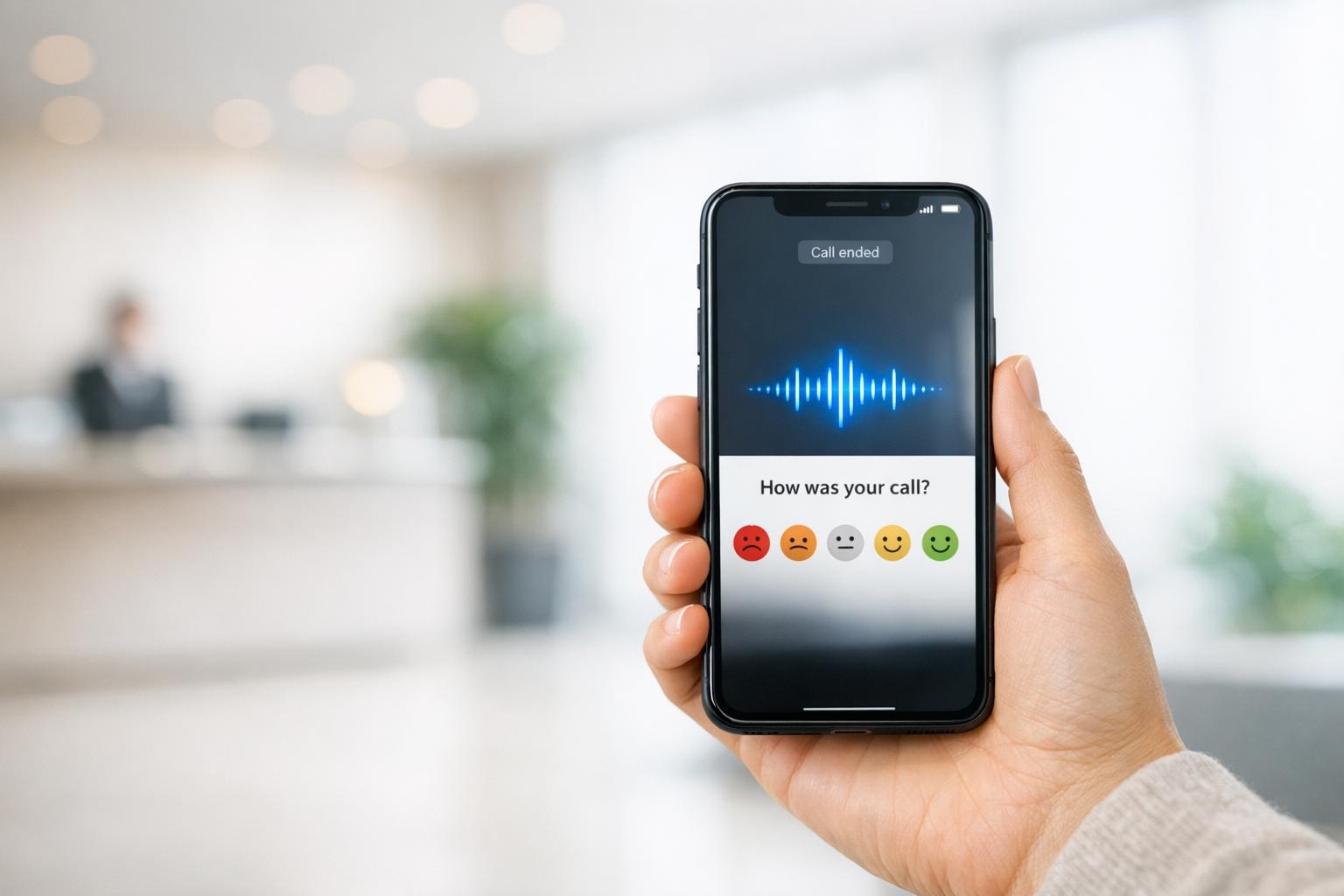
AI Post-Call Surveys for Guest Sentiment
Get 5x higher response rates and save 90% on feedback costs with AI voice surveys that start the moment your service call ends.

Written by
Adam Stewart
Key Points
- Turn service calls into instant feedback sessions
- Spot upset customers in real-time for immediate follow-up
- Automate 24/7 survey collection without hiring staff
- Send feedback data directly to your CRM system
AI post-call surveys are transforming how businesses gather guest feedback. These systems use conversational AI to collect and analyze sentiment immediately after a call, providing faster insights compared to email surveys. With response rates often below 10% for traditional surveys, AI surveys achieve higher engagement by seamlessly transitioning from a service call to feedback collection. This approach not only saves time and reduces costs by up to 90% but also helps businesses address issues in real-time, improving guest satisfaction and retention.
Key benefits include:
- Higher response rates: Automated, interactive surveys engage guests while their experience is fresh.
- Real-time sentiment analysis: AI interprets tone, emotion, and feedback to identify issues quickly.
- Cost savings: Automates feedback collection, cutting manual labor and operational expenses.
- Actionable insights: Pinpoints trends and recurring issues for immediate service improvements.
For small businesses, tools like Dialzara offer affordable solutions, starting under $100 per month, with easy setup and integration into existing systems. Businesses can personalize surveys to align with their brand, ensuring feedback feels relevant and genuine. AI post-call surveys are an efficient way to enhance service quality and maintain competitive advantage.
How AI Post-Call Surveys Work
Automatic Survey Triggering
AI post-call surveys kick off automatically through integrations with your business tools, such as Property Management Systems, CRMs like Salesforce or HubSpot, and ticketing platforms like Zendesk. These systems use webhooks and APIs to seamlessly connect and trigger surveys based on specific events - like completing a reservation, closing a service ticket, or reaching a post-checkout stage [2][3].
One of the smoothest methods involves end-of-call transitions, where the AI voice agent shifts directly into survey mode without ending the call. According to Retell AI:
Voice agents call flows can be built to handle calls naturally and, once the core task is complete, transition directly into a feedback prompt without switching modes or disrupting the customer experience [2].
This approach ensures guests remain engaged while their experience is still fresh in their minds. For guests who prefer other options, surveys can also be sent via WhatsApp, email, or SMS [3]. Once activated, the AI uses conversational techniques to collect feedback naturally.
AI Conversations for Feedback Collection
Natural language processing (NLP) allows AI to interpret guest feedback, capturing the meaning behind their words - even when they use idioms, colloquialisms, or regional dialects [1]. This capability ensures the AI understands nuances that traditional surveys might overlook.
These systems go beyond basic question-and-answer formats. If a guest mentions a specific issue, like noise complaints, the AI can ask follow-up questions tailored to that problem instead of sticking to a rigid script. This conversational flexibility helps mimic human interaction by adjusting to the guest's tone, mood, and emotional cues. Additionally, the AI can tap into historical guest data to personalize questions, making the conversation feel more relevant and engaging.
Real-Time Sentiment Analysis
AI doesn’t just listen to words - it analyzes tone, pacing, pitch, and other acoustic signals to uncover hidden emotions [2]. For instance, a guest might say, "everything was fine", but a flat tone or slow delivery could hint at dissatisfaction [2].
The system also handles multipolarity, where guests express mixed feelings, such as "I loved the room but hated the noise" [1]. When negative emotions are detected, the AI can trigger escalation protocols, notifying human supervisors to step in before the call ends [2]. This ability to act in real-time sets AI surveys apart, enabling businesses to address issues promptly and deliver faster resolutions.
sbb-itb-ef0082b
Benefits of AI Post-Call Surveys for Small Businesses
Higher Response Rates
AI-powered voice surveys often see better response rates than traditional email or text surveys. Why? Because customers are already on the phone. This smooth handoff from a service call to a feedback request eliminates extra steps, keeping customers engaged and more likely to respond. For small businesses that need quick and reliable feedback, this method ensures responses are immediate and relevant, creating a direct link between the interaction and the insights gathered.
Practical Insights from Feedback
AI doesn’t just collect feedback - it organizes it in ways that make sense. By categorizing responses, identifying patterns, and flagging recurring issues, AI transforms raw data into meaningful trends. For example, it can pinpoint which service aspects consistently receive praise or complaints. This allows small business owners to spot areas for improvement or celebrate what’s working well. Plus, tracking sentiment over time helps gauge the effectiveness of changes, offering a clear view of customer satisfaction.
Cost and Time Savings
Traditional post-call surveys can be resource-intensive, often requiring staff to handle follow-ups and analyze data manually. AI takes over these tasks, cutting costs and saving time while maintaining consistency. For small businesses operating on tight budgets, this automation removes the need to hire extra staff just for feedback collection.
Take Dialzara’s AI phone agents, for example. They run surveys around the clock - no breaks, no sick days, no overtime - and can integrate with over 5,000 business tools. This seamless connection funnels survey data directly into existing CRM and analytics platforms, streamlining operations and ensuring top-notch quality without adding extra workload.
Setting Up AI Post-Call Surveys with Dialzara
Quick and Easy Setup
You can deploy AI phone agents in minutes, making the setup process straightforward and fast. Begin by creating an account and answering a few questions about your business to help train the AI phone agent. Next, choose a voice and phone number, and set up call forwarding. From there, the system takes over, automatically triggering post-call surveys after each interaction. All survey data seamlessly integrates with your existing CRM and analytics platforms.
After the initial setup, you can focus on tailoring the survey experience to align with your brand's personality.
Personalizing Surveys to Match Your Business
Dialzara learns your industry's specific language during setup. By providing details about your business - whether you manage a law firm, medical office, or boutique hotel - the AI adopts the appropriate terminology. For instance, a hotel might design surveys asking about "check-in experience" and "room cleanliness" in a friendly and inviting tone. Meanwhile, an insurance office could focus on "claim processing speed" using professional, straightforward language.
But customization doesn't stop at words. You can adjust the AI's tone and style to reflect your brand's personality, making it feel like a seamless part of your team. This thoughtful approach ensures feedback collection feels genuine, encouraging customers to share honest and valuable insights.
Once your surveys are customized, Dialzara delivers consistent results around the clock.
Always-On Availability and Effortless Scaling
Dialzara's AI agents work 24/7, capturing customer feedback at any time without interruptions. As your call volume increases, the system scales effortlessly, maintaining high-quality performance. Whether your business handles 50 calls a week or hundreds a day, Dialzara ensures surveys are delivered consistently, with accurate sentiment analysis.
This constant availability means every piece of feedback is captured, no matter when the call happens. Plus, it’s a cost-effective solution - saving up to 90% compared to hiring additional staff, while eliminating the need for HR management or training expenses.
Best Practices for Getting Better Guest Sentiment Data
Traditional vs AI Post-Call Surveys Comparison
Survey Timing for Better Engagement
Send surveys right after a call ends to capture feedback while the experience is still fresh in the guest's mind. This real-time approach helps you pick up on emotional details like tone, pitch, and word choice, which can reveal how a guest truly felt about the interaction.
Automating survey triggers based on key moments - like the end of a call, a specific call length, or a first-time customer interaction - ensures consistent and timely data collection. These well-timed surveys integrate seamlessly with your sentiment dashboard, making it easy to analyze feedback as soon as it’s received.
Using Sentiment Dashboards
Once the survey data is collected, sentiment dashboards bring it to life. Powered by Natural Language Processing (NLP), these tools go beyond simple star ratings to analyze the guest’s tone, emotions, and even casual language. This means you can uncover the why behind a guest’s feelings, not just the what.
These dashboards make it easy to spot trends and patterns in guest sentiment. For example, if satisfaction scores dip, you can act quickly to address the issue before it grows. By providing immediate insights, the dashboards allow you to fine-tune service quality in real time, unlike manual survey methods that often come with delays.
Traditional vs. AI Post-Call Surveys
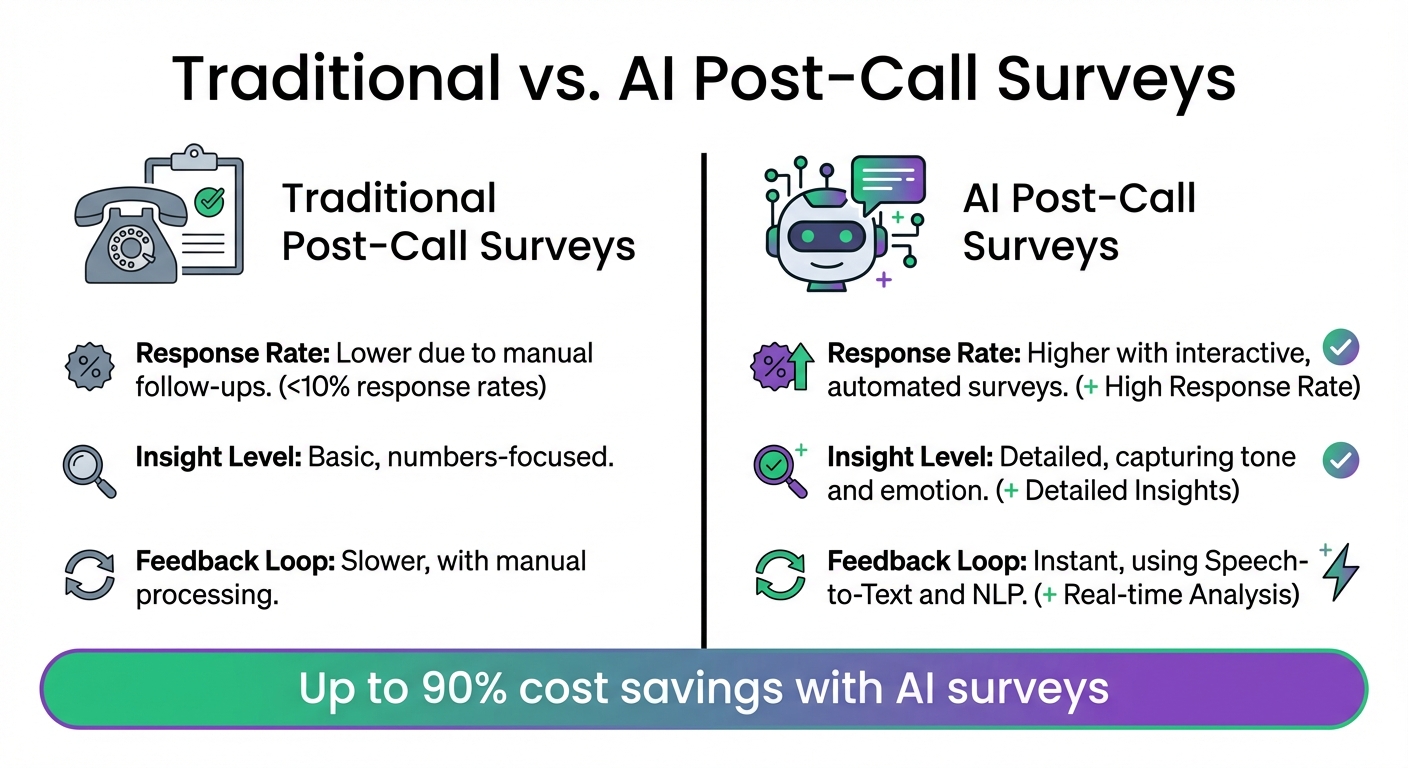
Here’s a quick breakdown of how AI-driven post-call surveys outperform traditional ones:
| Aspect | Traditional Post-Call Surveys | AI Post-Call Surveys |
|---|---|---|
| Response Rate | Lower due to manual follow-ups | Higher with interactive, automated surveys |
| Insight Level | Basic, numbers-focused | Detailed, capturing tone and emotion |
| Feedback Loop | Slower, with manual processing | Instant, using Speech-to-Text and NLP |
AI surveys eliminate the hassle often linked to traditional feedback methods. Guests can share their input effortlessly, without needing to fill out lengthy forms or carve out extra time. With tools like Speech-to-Text and NLP, businesses can gain a much deeper understanding of guest sentiment while making the feedback process smoother for everyone involved.
Conclusion
AI-powered surveys are changing the game when it comes to gathering guest feedback. They go beyond traditional methods by analyzing not just the words, but also the tone, offering a level of understanding that's hard to achieve otherwise.
With AI post-call surveys, businesses benefit from higher response rates, more meaningful insights, and substantial savings in both time and money. These systems automatically collect feedback right after a call ends, removing the need for manual follow-ups and making it easy for guests to share their thoughts.
Dialzara is designed to simplify this process. It integrates seamlessly with over 5,000 applications, sets up in just minutes, and operates around the clock, capturing every guest interaction. This means you'll always have access to critical sentiment data, no matter when the calls take place.
FAQs
What should I ask in an AI post-call survey?
When designing an AI post-call survey, it's important to focus on questions that uncover how customers feel about their experience and the service they received. Here are a few examples to guide you:
- General Satisfaction: Ask straightforward questions like, "How satisfied were you with your experience?" or "Did our service meet your expectations?" These help gauge overall customer sentiment.
- Specific Service Aspects: Dive deeper into particular areas like communication and professionalism. For instance, you could ask, "Was the agent helpful?" or "Was the information provided clear and easy to understand?"
- Open-Ended Feedback: Include questions that allow customers to share more detailed insights. Phrases like, "Do you have any suggestions for improvement?" can uncover valuable ideas for refining your service.
By combining these question types, you can collect both quantitative data and qualitative feedback, which together provide a well-rounded view of customer satisfaction.
How does AI detect guest sentiment from a phone call?
AI systems can gauge guest sentiment by analyzing vocal cues and language patterns as conversations happen. By evaluating aspects like tone, pitch, rhythm, and word choices, these systems can detect emotions such as frustration, confusion, or satisfaction. Leveraging machine learning and natural language processing, they process over 7,000 voice signals with an accuracy rate of up to 98%. This enables businesses to respond with empathy and address issues promptly, enhancing customer interactions and lowering the chances of abandoned calls.
How do I connect post-call surveys to my CRM or PMS?
To link post-call surveys with your CRM or PMS, try using an AI-driven feedback tool like Dialzara. Set it up to automatically send surveys through email, SMS, or app notifications after customer calls. Make sure it connects to your CRM or PMS using the provided APIs. The AI will process the survey responses and deliver insights straight to your system, making it easier to gather feedback and monitor customer sentiment effectively.
Summarize with AI
Related Posts
How Do Voice Agents Detect Customer Emotions and Sentiment?
AI analyzes customer emotions in real-time during calls, enhancing support, personalizing experiences, and preventing issues before they escalate.
Voice Sentiment Analysis: 7 Techniques That Help AI Understand Emotions
Explore seven key techniques in voice AI sentiment analysis that enhance customer interactions by understanding emotions in real time.
AI Voice Feedback: Boosting User Experience
Explore how AI voice feedback enhances customer experience, tackles common issues, and drives efficiency across businesses.
Voice AI: Improving Call Quality with Feedback
Explore how Voice AI enhances call quality through real-time feedback, saving costs, and improving customer satisfaction.