
Top AI Tools for Reducing Customer Service Errors
Cut customer service errors by up to 75% while saving 90% on support costs with proven AI solutions that handle calls, chats, and inquiries automatically.

Written by
Adam Stewart
Key Points
- Save 90% on call handling costs with AI phone answering services
- Reduce error rates by 75% using predictive analytics and automation
- Handle 83% of inquiries automatically with 98% accuracy rates
- Connect AI tools to 5,000+ apps for complete workflow automation
AI customer service tools are transforming customer service by minimizing errors, reducing costs, and improving efficiency. Businesses can now automate repetitive tasks, ensure consistent service, and handle up to 83% of inquiries without human involvement. By 2025, AI was projected to manage 95% of customer interactions, and companies report significant improvements in response accuracy and customer satisfaction.
Key takeaways from the article:
- Dialzara: AI-powered phone answering with 99.8% transcription accuracy, 24/7 availability, and seamless CRM integration. Cuts costs by up to 90%.
- Predictive Analytics: Anticipates customer issues with 90-95% accuracy, reducing error rates by 60-75%.
- AI Chatbots and Voicebots: Handle complex queries, resolve over 80% of issues autonomously, and operate 24/7 with 95-98% response accuracy.
- Agent-Assist Tools: Provide real-time suggestions for agents, ensure compliance, and improve call handling efficiency.
- Performance Metrics: Track and reduce errors using AI-driven insights like repeat contact rates and sentiment analysis.
These tools help businesses deliver faster, more accurate, and cost-effective customer support while freeing human agents to focus on complex tasks. SMBs, in particular, can benefit from AI solutions like Dialzara for quick deployment and error reduction.
Dialzara: AI-Powered Phone Answering for Error-Free Service
Phone calls are still a major part of customer service, but they’re often where things go wrong. Missed calls, incorrect messages, and inconsistent communication can damage customer trust. Dialzara steps in to tackle these challenges with an AI-powered phone answering service that boasts an impressive 99.8% transcription accuracy [5].
Unlike traditional call centers that require lengthy hiring and training processes, Dialzara is ready to go in minutes [5]. It runs 24/7/365, handling multiple calls at once so no one ends up in voicemail, even during holidays or late-night hours [5].
What sets Dialzara apart is its ability to integrate with over 5,000 business tools, including ConnectWise, Zendesk, and ServiceNow [5]. This means customer data flows seamlessly into your CRM or ticketing system, cutting down on manual data entry and reducing errors. For industries like legal, healthcare, and finance - where accuracy is critical - this automation ensures every detail is captured, helping businesses stay compliant.
How Dialzara Minimizes Errors
Human errors in call handling often stem from fatigue, distractions, or inconsistent training. Dialzara eliminates these issues by using automated ticket creation, intelligent call routing, and direct CRM integration [5]. When a customer calls, the AI collects key information, understands their request, and either resolves it or directs them to the right team member.
Dialzara also supports multilingual communication in 10 languages with automatic detection [5]. This feature ensures clear communication with non–English-speaking customers, making it an effective tool for reaching diverse audiences.
Another standout feature is the ability to set "do not say" rules and emergency protocols [5]. You can program the AI to avoid phrases that don’t align with your brand or might confuse customers. Additionally, it can identify emergencies and escalate them via SMS or email, ensuring urgent matters are handled immediately.
Cost Savings and Efficiency
Hiring receptionists comes with ongoing expenses like salaries, benefits, and training. Dialzara can cut these costs by up to 90% [5]. It’s particularly useful for businesses dealing with fluctuating call volumes, such as during seasonal surges, as it manages increased demand without additional expenses.
Unlike human employees, the AI doesn’t need sick days or vacation time. It delivers consistent performance, whether handling a single call or a high volume of complex inquiries. This makes it possible for small and medium-sized businesses to access top-tier phone support without breaking the bank.
Easy Setup and Scalability
Getting started with Dialzara is simple, thanks to its four-step setup process [5]. First, you create an account and either connect your current phone number or use one provided by the service. Next, you train the AI by providing information about your services, ticketing workflows, and emergency protocols. Then, you test the system by making calls and chatting with the AI to fine-tune its responses. Finally, you activate call forwarding, and the AI takes over [5].
Dialzara is designed to adapt to industry-specific terminology and customer interaction styles [5]. For example, IT and MSP companies can configure it to recognize SLA tiers and prioritize VIP clients [5]. This ensures the AI doesn’t just answer calls - it becomes a seamless extension of your business.
To make the decision easier, Dialzara offers a 7-day free trial with full access to all features [5]. This trial lets you test the system with real calls, fine-tune its settings, and confirm it meets your needs for reducing errors and improving efficiency.
sbb-itb-ef0082b
Predictive Analytics: Preventing Errors Before They Happen
Predictive analytics uses historical data and real-time patterns to stop problems before they arise. Instead of waiting for customers to report issues, these AI systems analyze past interactions, transaction histories, and behavioral trends to predict potential problems. Businesses using predictive monitoring often experience a 60-75% drop in error rates compared to traditional reactive methods [6]. This shift from detection to prevention allows companies to anticipate and address customer concerns with precision.
These systems rely on algorithms trained on massive datasets. Take Zendesk, for example - it trains its AI models using 19 billion historical support tickets to improve its ability to understand context and intent [1]. This extensive data helps the system identify when a customer might face an issue, like an expiring subscription or suspicious account activity, and triggers proactive outreach before the customer even notices.
Anticipating Customer Issues
Supervised algorithms can predict error-prone situations with an impressive 90-95% accuracy [6]. These systems monitor process parameters constantly and take preventive action when the likelihood of an issue is high.
For instance, during Black Friday 2024, a company using Level AI insights managed to deflect 500,000 calls to self-service options, easing the pressure of high call volumes [7].
Real-time sentiment analysis also plays a crucial role, identifying signs of frustration so managers can step in before a situation escalates. This sentiment-driven approach ensures that even subtle issues don't go unnoticed.
Better Customer Interactions Through Data
Predictive analytics doesn’t just prevent errors - it also enhances live customer interactions. By giving agents real-time context, these systems forecast message urgency and topics, ensuring the query reaches the most qualified agent and avoiding costly handling mistakes.
For example, ezCater, a food tech platform, used Level AI’s Real-Time Agent Assist and Manager Assist tools to optimize their customer support during busy lunch hours. With contextual insights and better call handling, they achieved a 13% reduction in overall call handling time, a 23% drop in call hold time, and resolved 94% of calls within 30 seconds [7].
These benefits are echoed by industry experts.
"Generative AI for customer service allows companies to move beyond simple answers and deliver proactive suggestions, tailored recommendations and even solve customer issues before they happen." - Matthew Finio and Amanda Downie, Staff Writers/Editors, IBM Think [8]
Companies that have fully embraced AI-powered customer service report a 17% boost in customer satisfaction (CSAT) and a 38% reduction in average inbound call handling time [8]. These gains come from the system's ability to predict customer needs and instantly provide relevant information, cutting down on repetitive back-and-forths that often lead to frustration.
AI Chatbots and Voicebots: Automated Customer Support
AI chatbots and voicebots have come a long way from basic, scripted interactions. Today’s systems leverage Natural Language Understanding (NLU) to grasp customer intent, emotions, and context - far beyond simple keyword matching. This means they can handle typos, slang, and even complex questions that traditional bots would struggle with. By 2025, it was predicted that AI would handle 95% of customer interactions, and recent figures show these systems now autonomously resolve over 80% of inquiries [2][10].
These advancements mean chatbots and voicebots can do more than just answer questions - they can complete multi-step tasks. With autonomous AI agents, they’re capable of processing refunds, updating customer accounts, or even scheduling appointments without needing human assistance [3]. This automation not only ensures consistent and precise responses but also significantly minimizes the errors often seen in manual operations.
24/7 Consistent Responses
One standout benefit of AI bots is their ability to deliver accurate and consistent answers anytime, day or night. Unlike human agents, who may vary in responses due to fatigue or differences in training, AI systems rely on verified knowledge bases to maintain precision [9]. When a bot encounters a query it cannot confidently handle, it uses predefined confidence thresholds to escalate the issue to a human agent.
The reliability of these systems is evident in their performance metrics. AI-powered bots achieve response accuracy rates of 95% to 98%, compared to the 85% to 92% range seen with human agents [6]. Add to that their round-the-clock availability - far exceeding the typical 8–12 hours of human coverage - and it’s clear why businesses are turning to AI for consistent, high-quality customer support [6].
Understanding Customer Sentiment and Intent
Modern bots don’t just process words - they analyze emotion and urgency. Sentiment analysis helps them detect feelings like frustration or disappointment by evaluating tone, language cues, and keywords. This allows the system to adjust its responses or escalate issues to a supervisor when necessary [3]. By addressing customer emotions appropriately, these bots reduce the risk of misinterpretation and service errors.
Semantic intelligence takes it a step further by tagging conversations with specific intents, such as "product setup" or "cancellations." This ensures the bot follows the right logic or directs the customer to the appropriate specialist [10]. Accurate routing reduces errors and ensures customers get the help they need without unnecessary back-and-forth.
The 2026 Zendesk CX Trends Report highlights this growing trust in AI, with 81% of consumers agreeing that it’s now essential for modern customer service [10]. Today’s bots can interpret complex requests with a level of nuance that rivals trained human agents.
"With AI purpose-built for customer service, you can resolve more issues through automation, enhance agent productivity, and provide support with confidence. It all adds up to exceptional service that's more accurate, personalized, and empathetic."
– Tom Eggemeier, CEO, Zendesk [11]
Companies that integrate AI-driven error prevention report a 60% to 85% drop in operational mistakes within just 12 months [6]. Sentiment-based routing plays a significant role in this improvement, showcasing how advanced chatbot capabilities can drive both efficiency and accuracy as part of a well-rounded AI support strategy.
Agent-Assist Tools: Supporting Human Representatives
Agent-assist tools are changing the way customer service teams operate by helping human representatives provide accurate and compliant support. While AI is great at managing straightforward customer interactions, human agents are still critical for handling more nuanced or complex situations. These tools work alongside agents, offering real-time suggestions and insights to help them deliver better service. By automating repetitive tasks, they also help reduce human error. In fact, 73% of agents say an AI copilot boosts their performance, and customer service representatives spend only 39% of their time directly interacting with customers [9].
Real-Time Support for Agents
Agent-assist tools act like a personal coach during live customer interactions. They offer on-screen prompts and guidance, helping agents navigate tricky conversations by suggesting the next best action based on what the customer says [3] [10]. These tools can instantly pull up relevant knowledge-base articles, draft response suggestions, and even summarize long conversation threads. This ensures agents have the full picture before they reply [1].
Compliance monitoring is another key feature. AI can track conversations in real time to make sure agents stick to required talking points and follow industry guidelines. This is especially important in fields like healthcare or finance, where using AI compliance monitoring platforms is non-negotiable [3] [1]. As one provider explains:
"AI can help agents hit all their talking points and ensure they're complying with playbooks at all times, reducing the chances of human error." [3]
AI-powered quality assurance tools also streamline the review process, cutting interaction review time by up to 80%. Businesses that use AI in customer service report a 25% boost in customer satisfaction [10] [12].
Beyond assisting agents directly, these tools pair well with smart call routing systems to further enhance the customer experience.
Smart Call Routing
Smart call routing takes the guesswork out of connecting customers to the right agent. By using Natural Language Understanding (NLU), these systems can interpret a customer’s tone and needs, prioritizing frustrated callers or escalating urgent issues to more experienced agents [10] [3].
Skill-based matching is another game-changer. Calls are routed to agents who have the right expertise, language skills, or a strong track record with similar topics [10] [1]. When a call is transferred from an automated system to a human, the agent receives a summary of the previous interaction and the customer’s intent, so the customer doesn’t have to repeat themselves [9] [12]. This seamless handoff ensures continuity and reduces the risk of errors.
Dynamic prioritization takes it a step further by factoring in details like account ownership, deal stage, and service-level agreements (SLAs) [1]. Behavioral triggers, such as a customer visiting a pricing page, can also route inquiries to specialists, ensuring the first agent the customer speaks to is well-equipped to resolve the issue [12].
| Feature | How It Reduces Errors |
|---|---|
| Smart Routing | Matches customers with agents based on skills, language, and sentiment for better support [10] [9] |
| Real-Time Transcription | Provides a live text record of calls, helping agents avoid missing important details [3] |
| Next-Best-Action | Suggests effective steps for agents based on past successful resolutions [12] |
| Automated Triage | Categorizes and prioritizes tickets by urgency, preventing high-priority cases from being overlooked [1] |
Performance Measurement: Tracking and Reducing Errors
Once AI-powered tools for error reduction are in place, keeping tabs on performance through detailed metrics becomes crucial for ongoing progress. Customer service teams are now prioritizing outcome-based evaluations - like whether issues are resolved correctly on the first attempt - over simply tracking activity. AI systems monitor 100% of customer interactions, offering complete transparency to quickly identify recurring error patterns [4].
Key metrics for reducing errors include the repeat contact rate (how often customers need to follow up about the same issue), the AI containment rate (the proportion of issues resolved entirely by AI without human help), and resolution accuracy (how well the AI understands customer intent and delivers the right solution). This shift toward measuring outcomes provides deeper insights into customer interactions.
Automated Customer Satisfaction Analysis
Using these metrics as a foundation, automated systems now assess every interaction for satisfaction and compliance. AI tools analyze customer language and tone to determine whether interactions were genuinely successful. This approach also helps identify "soft resolutions", where tickets are marked as closed even though the customer remains dissatisfied [13].
AI also ensures policy compliance by reviewing conversations to confirm that agents follow required procedures. For example, Zendesk QA, starting at $25 per agent per month, can uncover coaching opportunities by analyzing all tickets [1].
"In modern support ops, 'AI tools' should be judged by business outcomes, not features." – Fin.ai [4]
Some platforms have adopted outcome-based pricing, where businesses pay only for successfully resolved interactions. For instance, Intercom Fin charges $0.99 per resolved conversation, while Gorgias charges about $1.00 per automated resolution. This pricing model incentivizes providers to focus on precision rather than simply processing large volumes of interactions [1].
Error Tracking and Improvement
AI systems are also instrumental in identifying knowledge gaps and driving ongoing refinement. Tools like Freshdesk's Freddy Insights flag questions the AI couldn't answer or highlight areas where responses were unhelpful, helping teams update their documentation as needed [9][13].
Regularly reviewing AI failure patterns and updating content or policies based on these insights leads to steady improvements. For example, Intercom's Fin AI agent improves its resolution rate by about 1% each month as it learns from new data [1]. Confidence thresholds also play a key role in reducing errors - if the AI isn't confident in its response, it automatically escalates the query to a human [9].
The table below summarizes the key metrics used to track and address errors:
| Metric | What It Measures | Why It Identifies Errors |
|---|---|---|
| Repeat Contact Rate | Customers returning with the same issue | Indicates incomplete or ineffective initial solutions |
| Escalation Rate | Percentage of AI interactions handed to humans | Highlights gaps in AI training or understanding |
| Sentiment Score | Emotional tone of interactions | Negative trends can point to unhelpful or inappropriate responses |
| Policy Compliance | Adherence to required procedures | Non-compliance risks legal or financial consequences |
Generative AI tools have boosted issue resolution rates by 15% per hour, with newer agents benefiting the most. Additionally, 71% of customer support specialists agree that AI and automation enhance the overall customer experience [4].
Comparison of AI Tools for Error Reduction
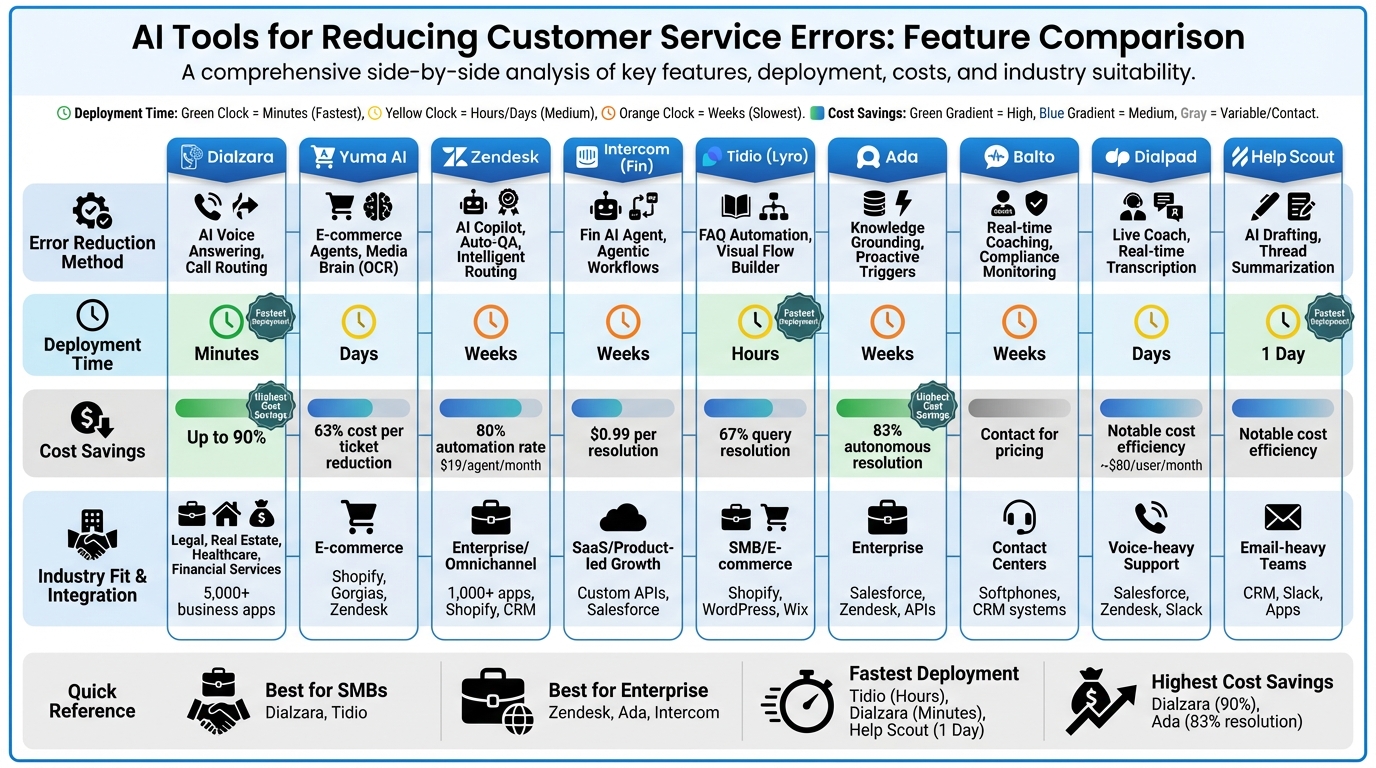
AI Customer Service Tools Comparison: Features, Costs & Deployment Times
The following comparison outlines key features of leading AI tools designed to minimize customer service errors. Choosing the right tool depends on factors like your business size, industry, and how quickly you need results.
For small to medium-sized businesses (SMBs) seeking quick phone support automation, Dialzara is a standout. It deploys in minutes, integrates with over 5,000 business applications, and can cut costs by up to 90% compared to hiring human staff. If you're in e-commerce, Yuma AI might be your go-to. It takes just days to set up and features a "Media Brain" capable of reading receipts and shipping labels to resolve tickets automatically.
For enterprises managing complex omnichannel support, Zendesk and Intercom (Fin) are popular choices. Zendesk, priced at $19 per agent per month, offers automated quality assurance to evaluate interactions, while Intercom charges $0.99 per successfully resolved conversation, ensuring you only pay for results. Meanwhile, Ada specializes in autonomously resolving up to 83% of interactions by grounding knowledge to reduce AI errors, though its implementation takes a moderate amount of time.
Voice-heavy contact centers might benefit from tools like Dialpad or Balto. Dialpad costs around $80 per user per month and offers real-time coaching and transcription, while Balto provides live suggestions during calls and flags compliance issues. For teams focused on email, Help Scout stands out for its rapid onboarding - most teams can start within a day - and its AI-assisted drafting ensures consistency in brand voice.
Comparison Table
| Tool | Error Reduction Method | Deployment Time | Cost Savings | Industry Fit | Integration Capabilities |
|---|---|---|---|---|---|
| Dialzara | AI Voice Answering, Call Routing | Minutes | Up to 90% | Legal, Real Estate, Healthcare, Financial Services | 5,000+ business apps |
| Yuma AI | E-commerce Agents, Media Brain (OCR) | Days | 63% cost per ticket reduction | E-commerce | Shopify, Gorgias, Zendesk |
| Zendesk | AI Copilot, Auto-QA, Intelligent Routing | Weeks | 80% automation rate | Enterprise/Omnichannel | 1,000+ apps, Shopify, CRM |
| Intercom (Fin) | Fin AI Agent, Agentic Workflows | Weeks | $0.99 per resolution | SaaS/Product-led Growth | Custom APIs, Salesforce |
| Tidio (Lyro) | FAQ Automation, Visual Flow Builder | Hours | 67% query resolution | SMB/E-commerce | Shopify, WordPress, Wix |
| Ada | Knowledge Grounding, Proactive Triggers | Weeks | 83% autonomous resolution | Enterprise | Salesforce, Zendesk, APIs |
| Balto | Real-time Coaching, Compliance Monitoring | Weeks | Contact for pricing | Contact Centers | Softphones, CRM systems |
| Dialpad | Live Coach, Real-time Transcription | Days | Notable cost efficiency | Voice-heavy Support | Salesforce, Zendesk, Slack |
| Help Scout | AI Drafting, Thread Summarization | 1 Day | Notable cost efficiency | Email-heavy Teams | CRM, Slack, Apps |
The table highlights how deployment speed, pricing, and industry-specific features vary across tools. For SMBs aiming for quick results and high ROI, tools like Tidio or Dialzara are excellent options. On the other hand, enterprises looking for advanced capabilities and are willing to invest more time might consider tools like Ada or Intercom (Fin). For those with extensive budgets, tools like Sierra, which typically require $50,000 to $200,000 in professional services fees and a 3–6 month setup period, may also be worth exploring.
Conclusion: Selecting the Right AI Tool for Your Business
Reducing errors isn’t just about cutting costs - it’s about building trust with your customers. Companies that implement AI-driven error prevention often see a 60% to 85% drop in operational mistakes within just a year [6]. For small and medium-sized businesses (SMBs), the right AI tool can revolutionize customer interactions while slashing costs by as much as 90% compared to traditional staffing models.
To get started, identify the top 20% of reasons customers contact you and focus on tackling the three most frequent issues [12]. This targeted approach allows you to run a manageable two-month pilot program that delivers clear, measurable results without overwhelming your team. Choose tools with strong natural language understanding - ones that can handle typos, slang, and other quirks in communication [7][12]. Additionally, ensure the tool offers seamless human handoff, so customers don’t have to repeat themselves when escalating to a live agent [7][15]. This method lays the groundwork for smooth integration and immediate error reduction.
Integration is key to making AI work in real-time. Your chosen tool should connect effortlessly with your existing CRM, scheduling software, and knowledge bases [7][12]. For example, Dialzara can be deployed in minutes and integrates with over 5,000 business applications, making it a great option for SMBs looking for quick results.
Beyond functionality, prioritize tools that combine emotional intelligence with compliance. Opt for solutions that can detect customer frustration while adhering to regulations like GDPR, PCI, or ISO standards [7][12]. As McKinsey experts Lars Fiedler and Nicolas Maechler explain:
"The AI-powered next best experience capability can enhance customer satisfaction by 15 to 20 percent, increase revenue by 5 to 8 percent, and reduce the cost to serve by 20 to 30 percent" [14].
Ultimately, the goal is to solve customer problems quickly and efficiently. With 90% of customers expecting immediate responses [12] and AI tools capable of handling 80% to 90% of routine inquiries [6], the question isn’t whether to adopt AI - it’s about finding the right tool that aligns with your business needs and can be implemented without delay.
FAQs
What should I automate first to quickly reduce support errors?
Automating call answering and transfers with an AI-powered virtual phone answering service can revolutionize how your business handles customer interactions. These tools provide consistent, round-the-clock service, ensuring no call goes unanswered while minimizing mistakes that can occur with human operators. By integrating such technology, you can simplify your support processes and manage inquiries more efficiently, giving your customers a dependable experience every time.
How can I measure if AI is reducing errors?
To determine whether AI is helping to cut down on customer service errors, start by comparing error rates from before and after its implementation. Look for issues like incorrect responses or misrouted inquiries. Incorporate feedback loops to fine-tune the AI's performance, and establish confidence thresholds that signal when a human should step in. Keep an eye on metrics like customer satisfaction scores, repeat inquiries, and escalation rates to gauge improvements in accuracy and the overall quality of service.
How can Dialzara hand off calls to humans without losing details?
Dialzara streamlines call handoffs with configurable confidence thresholds and triggers, ensuring the entire conversation context is preserved. This means 73% of customers avoid repeating themselves during escalations. The result? A smoother transition that benefits both your team and your customers, keeping interactions efficient and frustration-free.
Summarize with AI
Related Posts
How AI Ensures 24/7 Customer Service Availability
Explore how AI enhances customer service with 24/7 availability, improved experiences, and seamless integration into business operations.
What AI Tools Help Reduce Wait Times in Customer Service?
Explore how AI is revolutionizing customer service by significantly reducing call wait times and enhancing operational efficiency.
How Voice AI Automates Customer Service
Explore how Voice AI enhances customer service with cost savings, efficiency, and 24/7 support for businesses of all sizes.
AI-Powered Customer Service: Cost Breakdown
Explore how AI-powered customer service reduces costs, enhances efficiency, and transforms customer interactions with 24/7 support and personalized experiences.